Wednesday, 29 September 2021

Part 2 - Energy Storage


In Part 1 - The Role of Renewable Energy, I discussed various options for low carbon, or carbon free, energy generation. I concluded that, unless grid-scale energy storage is available, the variability of the most rapidly expanding renewable energy sources, i.e. wind and solar PV, limits their penetration into electricity generation and distribution systems. So what options are available for large scale energy storage?

There are many ways of storing and recovering energy. For electricity the one we are most familiar with is the use of batteries.

Battery storage
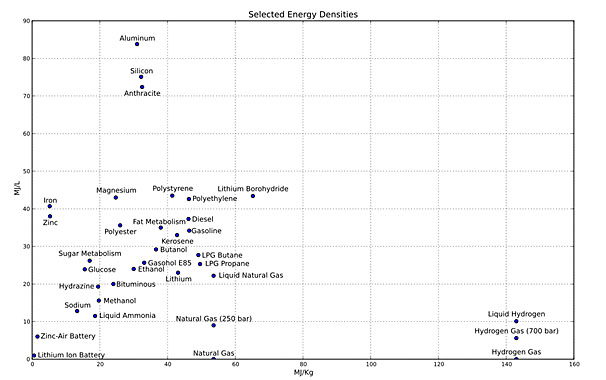
The following graphic, which plots energy density in MJoules/litre against MJoules/kg, puts into context the energy density of Lithium Ion and Zinc-Air batteries relative to other substances. The significance of energy density is that gasoline, for example, effectively stores about 50 times more energy per kg than lithium ion batteries and so is a much more portable energy source. This is important for powering aircraft and heavy vehicles.


As a result of its use in electric vehicles, battery storage technology is developing and getting cheaper; but currently batteries are still expensive, have low energy densities and a limited life. In addition as the demand for batteries increases there will be issues to face regarding the price and availability of the minerals which they need for their manufacture. According to Mark Mills in the video above (30:20) changes to the battery chemistry will not fundamentally improve this situation.

In my view both energy density and longevity would need to improve significantly before the use of batteries to smooth out variable production from renewables on time scales, of say 4 to 12 hours or more, would become economic on a grid scale. There are, nonetheless, many battery storage schemes planned or under construction in the US and internationally.

The planned UK scheme at London Gateway, Thurrock, Essex has a peak output of 320MW and a storage capacity of 640MWh. Thus, if the batteries can tolerate 100% discharges, it has a theoretical run time at maximum output of 2 hours but it’s difficult to know what proportion of connected demand this represents.

Compare this to the proposed 3.6GW Dogger Bank Wind Farm in the North Sea, which is being developed in three phases of 1.2GW each, and it’s clear that Battery Storage projects are a long way from acting as medium term backups to Wind Power Generation. (A Gigawatt is 1,000 Megawats).


There is also a 185 MWh battery installation in operation, the Hornsdale Power Reserve, in South Australia, which has a full output rated at 150 MW. This installation is used for frequency and voltage stabilisation and is very fast acting, being able to put power into the grid in milliseconds, and thus smooth out shocks and transients caused by generation blips and load switching. Using the equipment to support electricity supplies in this way has generated significant savings by driving down the cost of providing fast despatchable power, which is otherwise expensive due to the need to run fossil fuel generators in standby mode. Australia’s electricity supply is heavily dependent on coal fired power stations and it remains to be seen whether the use of renewables like wind or solar, combined with battery storage, can be competitive or even politically palatable.

What can be confidently said is that battery storage is going to become more and more important in supporting supply grids with a high penetration of variable renewables in the future.

Energy storage in molten salt
By heating up a salt until it’s molten, energy can be stored in tanks of the hot liquid salt for later recovery by power generation systems. This has been done on the full scale in several solar power plants using directed mirrors in the USA, Spain, and China.

Andasol solar power plant, Spain


It’s also proposed as an adjunct to high temperature reactors such as the Moltex SSR with GridReserve® and the TerraPower Natrium reactor, so that the stored heat can be used to run generators and provide peak power outputs when required.

Other types of energy storage
Other energy storage systems are being proposed and investigated, and some may be promising in the long term, but most are not yet proven to be economically viable or available for widespread deployment. Some of them are discussed below.

Generation of hydrogen
An interesting example is the proposal to use surplus energy generated by wind and solar, when it’s not required by the grid, to produce hydrogen by electrolysis which can be compressed and stored until it’s used: either to blend into natural gas distribution networks, or to power vehicles and aircraft, or to generate electricity during periods of low output from renewables.

The disadvantage with these concepts is their overall efficiency. For example the efficiency of electrolysis is currently 60-70% and the ongoing conversion back into electricity is 40-60% (depending on the method used). Thus the overall efficiency of the round trip is 24-56%, which is much lower than batteries, and there is also the energy cost of compressing the gas for storage but, providing there are periods of overcapacity of installed renewable electricity generation, the electricity used is effectively free.

Work is ongoing to establish the overall economic viability of hydrogen generation and storage.

Some boiler manufacturers like the UK company Worcester-Bosch are conducting long term research to determine the viability of using hydrogen blended with natural gas in a domestic setting. They have found that blends of up to 20% hydrogen require only minor changes to natural gas boilers.

Hydrogen can cause embrittlement of metals and some types of steel used for high pressure gas distribution pipelines may need to be lined or replaced depending on the steel used. Pipelines made from cast iron, polyethylene and elastomeric polymers are unaffected and so the operators of domestic networks are not at risk of major expenditure.

There are also other ways of generating hydrogen using high temperature chemical reactions that fit very well with new nuclear technologies.

Liquid air energy storage
A further method which is getting serious consideration and development is the use of liquid air as an energy storage medium. Similarly to the production of hydrogen, electricity production from wind and solar would be used to liquefy air at atmospheric pressure and when required it can be evaporated under pressure to drive generators.


A 5MW/15MWh demonstration plant, constructed by Highview Power, has been in operation since 2018 at Pilsworth, Bury, UK. Construction has started on an £85m project at Trafford Energy Park, Manchester, UK, which is due for completion in 2022 and will store 250 MWh of energy. The round trip efficiency of such systems is low at around 25% but this can be enhanced, with the use of a cold store, to 50%. If the facility is located near a source of waste heat like an industrial process or thermal power generation system, the efficiency can be further enhanced, and Highview Power claims 70%, without the need to augment the capital cost with heat recovery systems.

Electric vehicles
Another idea is that, when required, electricity could be fed back into the grid from the batteries in electric vehicles: and therefore at some future date a large battery storage capacity would be available to smooth out shortfalls between generating capacity and demand. Although this Vehicle to Grid concept is now being marketed by Nissan and Ovo, it's unclear how it would be managed on a large scale, but it would probably need an infrastructure that had connection points at the majority of parking places; as well as some form of smart metering that credited the vehicle owner if stored electricity, that had already been paid for, was drawn out of the vehicle's batteries. These connection points, or the vehicles themselves, would also need to be equipped with inverters capable of converting DC battery current into AC power and synchronizing it with the grid. This concept has the attractive characteristic that the extra cost of adding these facilities to the charging infrastructure or the vehicles themselves is marginal.

The transition to electric vehicles, which is happening at a surprisingly fast rate, will make a contribution to the reduction in greenhouse gases from burning hydrocarbon fuels. Even if the electricity to charge vehicle batteries comes from gas-fired power stations there will be some efficiency savings and hence overall less carbon dioxide and nitrogen oxides will be discharged to the atmosphere.

But the requirement to charge an ever growing fleet of electric vehicles will put an increasing burden on the electricity supply network. So, without making any allowances for the higher efficiency of electricity versus gasoline when powering vehicles, for the UK I calculate this will require 7 new power stations to be built each year over the next twenty years.

Total number of litres of road fuel in UK per year    45,000,000,000 l/yr
US EPA says 1 US gallon gasoline is 33.7 kWh        34
1 US gallon is 3.785 litres -                                   3.785l /US gallon
so to replace all road fuel would need                    400,660,501,982 kWh/yr
or per day                                                           1,097,700,005 kWh/d
or an average instantaneous demand of                 45,737,500 kW or 45,737 MW
allow double for peak load                                     91,474 MW
Each medium sized power station gives                  700 MW
so it would need                                                   131 new power stations 
or over 20 years -                                                 
per year

If anyone feels like checking this calculation they’re welcome!


Pumped hydro
One system that has been proved to be viable for energy storage is pumped hydroelectricity, which has had plants in operation for decades. They require two large lakes, one several hundreds of metres above the other.

Water is pumped up when electricity costs are low and released through turbines to generate electricity when required. Due to pump/turbine efficiencies and the two way conversion, the electricity recovered is only about 70-80% of the electricity input. The geographical opportunities for such installations are few, and so far they have only been used for providing flexible power for relatively short durations at peak times when the feed-in tariff for electricity is high.


An example is Dinorwig power station in North Wales which was started in 1974 and completed in 1984.

There are ten such schemes under construction in Europe totalling 1,339MW of capacity. To put this into context, these schemes would add less than 0.1% of the total energy consumption of the 28 EU countries in 2015 as storage capacity. (This total was 12,609 TWh, equivalent to a continuous consumption of 1.44TW. A Terawatt TW is 1 million Megawatts).

Backup power
Backup power production capacity or energy storage is therefore necessary to supply the demand for energy when wind and solar can’t and, because it takes time to bring generating capacity on line, some backup systems have to be kept running even when the demand is being satisfied by renewables.

The German experiment
Under the German EnergieWende, in which it’s intended to move away from fossil fuels and nuclear power to a low-carbon energy economy, up to 2014 they have been running lignite and hard coal fired power plants to replace the energy generated by nuclear plants which have been taken out of service, and to provide backup to wind and solar. During these years the consumption of gas has also been reduced: so the increase in energy from renewable sources has been offset by the reduction in the least carbon dioxide producing sources i.e. nuclear and gas.


The following graphic shows German energy consumption updated to 2019 and corrected for efficiency. 


This means that the vertical axis depicts the amount of primary energy required to generate the indicated amount of TeraWatt hours of electricity. 
Since 2014 the proportion of coal and nuclear electricity generation has decreased, that of gas and oil has stayed the same, whilst wind power has on the other hand increased. So far so good, but it’s clear that the total output from renewables has a long way to go before it represents a significant proportion of total generation capacity. Furthermore if electricity production is ever to be carbon free then the consumption of oil, coal and gas needs to be reduced to zero.

Coal is the most polluting fuel
Coal, and particularly lignite, is the most polluting of all the fuel options since, due to lower efficiencies, legacy plants produce more carbon dioxide per MWh than other fossil fuels and release, into the environment pollutants: including particulates; sulphur and nitrogen oxides; and ash. Ash contains uranium and is 100 times more radioactive than nuclear waste. It also contains heavy metals which will never decay and become less polluting. This ash is typically dumped or stockpiled with minimal control and has caused serious ash-slides necessitating dangerous clean up work


Air pollution from burning coal is even more serious because it travels further. If, like me you are old enough, you may remember the acid rain arising from UK coal burning power stations that acidified Scandinavian lakes in the 1980's. 


The horrific air pollution in China also dramatically illustrates the results of burning coal and is responsible for many premature deaths.

Germany has passed a law intended to phase out coal fired power stations by 2038.  This will commit Germany to closing all of its coal and lignite fired power stations, but it will clearly be very difficult to phase out both nuclear and coal fired generation, which together represent more than 50% of current capacity, and replace them with intermittent renewables. It’s not clear how Germany intends to fill the gap that it appears likely to create without a change of policy but it will probably be plugged by burning Russian gas.
In effect the German EnergieWende amounts to an experiment on a national scale.

You can be paid for using electricity!
Another effect of relying more and more on renewables has occurred in Germany on some sunny and windy days. Because German law forces their grid operators to accept renewable energy in preference to that from fossil fuels, and electricity production from fossil fuels cannot easily be ramped down, on occasions the price of electricity has become negative in response to an over-supply, meaning that commercial consumers are being paid to burn more electricity!

But Germany is not alone in this situation. In the UK, where there is a free market for electricity, there have been whole weeks when the day-ahead wholesale price of electricity was negative and on 21st May 2020 it fell to an average over 24 hours of minus £9.92/MWh.

It’s clear that this is a ludicrous waste of an otherwise precious resource that results in some measure from subsidies and, apart from providing windfalls to large industrial users who are able to ramp up their energy consumption, it has no advantages. This energy should be used for other purposes which are viable without continuous power, such as, perhaps, generating hydrogen for storage.

Renewable power alone is not the exclusive answer
My conclusion is that, over any specific 24 hour period, renewables can only satisfy a proportion of the total energy demand on any supply grid and a mix of different generation sources and storage types is necessary,


The next article, Part 3 Nuclear Power and the Reduction of Carbon Dioxide Emissions, advocates the use of nuclear power to secure the base load when wind and solar can’t. 
To enable the reader to contrast the technology of the current fleet of 2nd generation nuclear reactors constructed in the 1960’s and 70’s with the more recent and safer designs, that are explained in part 4 of this series, the next article  goes on to describe what second generation nuclear reactors contain and how they work.


Tuesday, 28 September 2021

Part 3 - Nuclear Power and the Reduction of Carbon Dioxide Emissions

In the previous article I concluded that intermittent renewable energy sources, like wind and solar PV, will not be sufficiently reliable to fully replace fossil fuels. Furthermore, even with an installed overcapacity of such sources, energy storage options are insufficiently developed to power electricity supply grids during periods of low renewable energy production and, if nuclear generation is ruled out, fossil fuel powered backup generating stations will be required.

Ross Koningstein and David Fork are engineers at Google who worked together between 2007 and 2011 on the renewable energy initiative somewhat geekily known as RE<C". From a position of strongly supporting renewables as the answer to the climate crisis, and following modelling studies, they came to the view that renewables alone would be insufficient to address the requirement for enough carbon free energy to halt the increase in atmospheric carbon dioxide.
“As we reflected on the project, we came to the conclusion that even if Google and others had led the way toward a wholesale adoption of renewable energy, that switch would not have resulted in significant reductions of carbon dioxide emissions," wrote Koningstein and Fork.”

So what would it really take to limit or even reverse climate change if today's renewable technologies by themselves aren't enough?

Koningstein's and Fork's research led them to think that a new technology is required, which will disrupt the existing status quo, but beyond discussing smarter, distributed, small scale power generation, they didn’t specify which technology, or deal with the need to act now and not wait in the hope that something new will emerge.

Environmentalists for nuclear and renewables
Taking into account the variability of wind and solar, and the current status of energy storage technologies, I've come to the conclusion that, alongside renewables, the only energy production technology that is available to be deployed on a global scale over the next twenty to thirty years, which will not contribute to climate change, is nuclear power.

In this video James Hansen explains why he has reached the same conclusion.


Other environmentalists also expand on their reasons for changing their view of nuclear power in this video.


So, together with a growing community of engineers, scientists and environmental campaigners, I am proposing nuclear power alongside renewables as the future for reducing carbon dioxide emissions and slowing the increase of the atmospheric concentration of greenhouse gases.

The example of France
As a result of the 1973 Oil Crisis, and its lack of natural fossil fuel resources, France decided, on the grounds of energy security, to rapidly expand its fleet of nuclear reactors and most of the plants currently in operation were built in the 70’s and 80’s. There are at present 56 active power reactors and, over the 30 years between 1990 and 2019, nuclear power generation has saved around 49 million tonnes of carbon dioxide from being discharged to the atmosphere. France exports electricity to nearly all its neighbours and earns €3 billion per year from this.


I quote this example to illustrate that a major change of technology can be implemented in a relatively short time, with highly effective results.

What does a nuclear power station contain?
Since, however, not many people have studied nuclear technologies; I will take the liberty of briefly explaining how reactors work and the degree of diversity of designs that have been built.

The primary components of any nuclear power generation system are the following;

· A critical mass of fissile material;
· A containment structure;
· A power supply and control system;
· A cooling/heat transfer loop;
· A power generation system (a means of turning the heat into electrical power).

A critical mass of fissile material is created when there is enough of the  radioactive components and they are sufficiently close to each other that the neutrons generated by the fission of one atom set off a chain reaction by stimulating other atoms to fission. This process generates heat and the neutron flux must be carefully controlled so that the rate of fission does not outpace the ability of the cooling system to remove heat from the reactor core. This is traditionally done by inserting and adjusting control rods of neutron absorbing materials like boron or hafnium. Clearly these reactions need to be contained and not allowed to disperse into the environment. The type of containment depends on the conditions of temperature and pressure inside the reactor but usually comprises a metallic reactor vessel inside a reinforced concrete containment structure.

There are many types of nuclear reactors.

Reactor regime                Thermal or Fast neutron spectrum

Fissile material                 in solid or liquid form

Cooling/heat transfer        by water, molten sodium, molten lead, molten fluoride                                         or chloride salts, carbon dioxide or helium gas.

Thermal spectrum reactors with a moderator, such as graphite or water, are the most common. As of April 2020, there are 440 power reactors in the world, operating in the thermal spectrum, with a combined electrical capacity of 390 GW. Additionally, there are 55 reactors under construction and 109 reactors planned, with a combined capacity of 63 GW and 118 GW respectively,

The fast spectrum is currently employed in four active reactors worldwide.

How does a nuclear reactor work?
The article “NUCLEAR 101: How Does a Nuclear Reactor Work?” explains in a simplified way how the two most common types, “The Pressurized Light Water Reactor PWR” and the “Boiling Water Reactor BWR”, function.

Pressurized water reactors


Solid fuel, second generation pressurized light water reactors (PWRs), are the most common type of nuclear reactor currently in service and make up two thirds of the US fleet but, whilst they have made a major contribution to carbon free power over the decades, I am convinced that they are not the best option for the future, other than as a short term stop-gap solution. 

PWRs were originally designed to be used in submarines for which, being surrounded by emergency coolant, they are ideally suited and they represent a design that dates from the late 1960's. There has been little improvement since then.

Explosion Risks
In order to generate high temperature steam at around 300 deg C, PWRs run at a pressure of over 300 bars (atmospheric pressure is equal to one bar) and therefore carry an inherent risk of explosion. To guard against a reactor vessel failure they need thick heavily reinforced concrete containment vessels. They burn enriched uranium fuel which generates waste with very long lived radioactive transuranics and actinides. Also they can only burn 4 or 5% of this fuel before the fuel rods deteriorate and must be replaced. Typically one third of the fuel rods are replaced every two years and kept in storage ponds until they are reprocessed to recover the remaining reusable fuel.

Boiling water reactors


Boiling Water reactors run at lower pressures of 70 -150 bars but are otherwise similar to PWRs in their fuel types and safety issues.

Emergency reactor shutdowns
Another major concern with many of the second generation reactor designs currently in service is that, when a reactor shuts down unexpectedly, and there is no power available from the grid, they need backup power supplies in order to run pumps and therefore maintain the cooling needed to remove the heat from the radioactive decay of fission products. This was what failed at Fukushima Daiichi, where the backup generators were in a location which was only designed to resist a 3 metre tsunami and were consequently put out of service.

More recent generation III+ PWR designs currently awaiting approval or under construction do, however, incorporate passive cooling, meaning that once shut down, they don't need power to dissipate decay heat. Other safety features are also included.

Liquid Metal Fast Breeder Reactors


Some types of reactor operating in the fast neutron spectrum, like the liquid metal fast breeder LMFBR, which uses molten sodium as the coolant medium, have other disadvantages. Sodium metal in liquid form is a good coolant, which operates at higher temperatures and lower pressures than water, and is a very good heat transfer material, but it reacts with air, and violently reacts with water. So the possibility of a leak between the liquid sodium and the steam generating sides of the heat exchangers is a serious safety concern. These types of reactors, depending on their size and design, can also have an overall positive temperature coefficient of reactivity, meaning that as the temperature rises, nuclear reactions increase and create more heat.

Such matters can, however, be overcome by good design. The Experimental Breeder Reactor at Argonne (EBR II) included passive safety features and was successfully tested in 1985 under conditions simulating power failure.

Terra Power
, a company sponsored by Bill Gates, is proposing a reactor using the fast spectrum, with cooling by molten sodium.
The project features a 345 MW sodium-cooled fast reactor with a molten salt-based energy storage system. The storage technology can boost the system’s output to 500 MW of power for more than five and a half hours when needed.

Fast spectrum nuclear reactors can also be designed to breed fissile fuels, such as Plutonium 239 and Uranium 233, from naturally occurring fertile materials like Uranium 238 and Thorium 232. They can also be designed to burn waste from operational reactors using the Uranium/Plutonium fuel cycle.

Service temperatures
Reactors currently in service can run at temperatures ranging from 300 deg C for PWRs to 650 deg C for the Advanced Gas Cooled Reactor. The higher the temperature, the more efficiently the power generation system can function.

Still higher operating temperatures of up to 1000 deg C are proposed for the Gen IV High Temperature Gas Cooled Reactor. This opens up the possible application of nuclear power to generate process heat for industry and thus replace fossil fuel usage.

Much research is being directed to determining the long term resistance of materials to the neutron flux in advanced reactor designs, their limitations, and their suitability under operating conditions of high temperature and pressure.

Nuclear safety
Most people object to nuclear power due to safety concerns and the longevity of nuclear waste. Let’s discuss safety first; nuclear waste will be dealt with in part 4 of this series of articles.

In spite of the age of most of the nuclear plants currently in service, on a global scale, there have been very few incidents involving nuclear reactors which have had major consequences, and two of those were at plants with fundamental design flaws.

At Chernobyl, where 64 people died of acute radiation sickness after emergency work, the reactors were never provided with containment vessels and they had other design flaws which would never have been permitted in Western countries.

At Fukushima Daiichi the backup power plant was flooded by the very large tsunami that we tend to forget resulted in over 18,000 people dead or missing. The several dozens of direct casualties at Fukushima are attributed to the effects of the evacuation of the surrounding area on the sick and elderly, but some workers have received radiation doses which exceed lifetime safety limits.

At Three Mile Island operators did not react appropriately when a pilot valve failed and, by sticking open, allowed coolant to escape. This fault had occurred on 11 previous occasions!

Estimates of future deaths related to radiation exposure from these accidental releases of radioactive material vary widely depending on their source, the methods used and the assumptions made. For example for Chernobyl in 2006 the WHO estimate of radiation related premature deaths was 4,000 whereas the Greenpeace estimate was 200,000! In 2008 another WHO report urged caution in the development and use of projections (paragraph 110).
The UN Scientific Committee on the Effects of Atomic Radiation makes the following statement in their report revised on 6th April 2021 concerning Chernobyl.

Quote<< Apart from the dramatic increase in thyroid cancer incidence among those exposed at a young age, and some indication of an increased leukaemia and cataract incidence among the workers, there is no clearly demonstrated increase in the incidence of solid cancers or leukaemia due to radiation in the exposed populations. Neither is there any proof of other non-malignant disorders that are related to ionizing radiation. However, there were widespread psychological reactions to the accident, which were due to fear of the radiation, not to the actual radiation doses. >> Unquote

It must be said that this conclusion has been contested by statements made by some of the personnel (called liquidators) involved in the emergency work, the subsequent clean-up and also in various research reports.

Estimates of premature deaths are controversial and the methods for calculating them are disputed by respected scientists. A full discussion would occupy too much space in this context, as would an examination of the number of fatalities in other industries associated with energy production, like coal mining. As the table below shows, all energy production carries risks and is responsible for fatalities.


Rates for each energy source in deaths per billion kWh produced. Source: Updated (corrected) data from: World Health Organization; CDC; Seth Godin; John Konrad.

In fact you are exposed to less radiation standing next to a nuclear reactor than flying in a plane at 30,000 feet but the specific point I wish to make is that even safer nuclear power options are available than those which are currently in operation. 

In the next article, I deal with innovations in nuclear power generation and discuss safer options than the familiar pressurized water reactors that have been in use since the 1960-70’s.


Monday, 27 September 2021

Part 4 – Safer Nuclear Power using Molten Salt and Thorium Reactors

 Molten salt reactors mean inherently safe nuclear electricity

In view of their potential safety issues a shift away from PWR’s and fast breeders, designed in the 60's and 70's, towards new inherently safe plants would be very welcome.  Ideally these should: 

  • operate at atmospheric pressure and so couldn’t explode; 
  • be unable to overheat or meltdown; 
  • be designed to be walk-away-safe in the event of power failure; 
  • have a negative temperature coefficient of reactivity: meaning that as the reactor temperature increases its output reduces;
  • allow load following and rapid output changes;
  • produce much less waste with a much shorter radio-active half-life. 

Of the various proposed Generation IV nuclear reactor designs there is one which fulfils all of these criteria, the liquid fuelled thorium reactor (LFTR).

On 14th July 2011, thanks to Ken Pottinger (now sadly deceased) of French News Online, I became aware of an alternative to current PWR technologies, which is based on 
liquid fuelled thorium reactors LFTRs and the Molten Salt Reactor Experiment. In this context a salt is the chemical term for a compound of a metal and a halide such as a fluoride or a chloride e.g. lithium fluoride. At the time I had no idea that nuclear reactors could have many design variants and even work in the liquid phase.  I spent several days researching the topic and wrote this piece on my blog summarizing my findings. 

The molten salt reactor experiment

A prototype molten salt reactor, operating at atmospheric pressure, ran at Oak Ridge National Nuclear Laboratory (ORNL), Tenessee in the 60’s and 70's.  The film below, made at the time, shows how this pilot scale plant was designed,built and operated.


The Molten Salt Reactor Experiment (MSRE) ran for more than 13,000 hours at full power, without significant materials problems, and successfully demonstrated the viability of the concept.  At the weekends, when they didn’t want to have staff on duty, they used to turn off the power, the fan cooling the freeze valve below the reactor vessel would stop, the plug of solid salt would melt and the reactor contents would drain by gravity into storage tanks. Since these did not contain a moderator to slow down the neutrons the chain reaction would stop. It was truly walk away safe!

To turn it into a commercial product there is more development work needed on the optimization of the waste processing stages, and also on the materials necessary to resist the high temperature and intense radiation environment over the long term. At the time that the project was shut down, ORNL had already started to work on these areas. We are fortunate that the work on the MSRE at Oak Ridge was very fully documented and these documents are in the public domain.

The fuel used for the MSRE was Uranium 233 produced in a reactor at Hanford. It was intended that at a future stage the reactor design would be modified to work as a breeder reactor producing U233 from Thorium 232 in a self-sustaining way. This would require the development of a chemical process to separate the U233 formed in the blanket and send it to the reactor. Unfortunately the project was shut down before this was fully progressed.

Kirk Sorensen has been actively promoting this technology and he explains in this video how he came to rediscover molten salt reactors and Thorium as an alternative fuel.

What about nuclear waste?
But the specific concern of many people is with the management of nuclear waste. 

The composition and quantity of nuclear waste depends on the fuel used in the reactor and the degree to which the fuel is burned.  Pressurised water reactors running on the Uranium 235/238 fuel cycle can only burn about 4-5% of the fuel contained in their fuel rods, which deteriorate and have to be replaced every 18 months.  During this operation the reactor is taken out of service.


Liquid fuelled reactors can burn a much larger percentage of their fuel than solid fuelled reactors because, by bubbling inert gas through the molten salt, it’s so much easier to remove gaseous fission products like Xenon 135, which poison nuclear reactions by absorbing neutrons.  Also, by incorporating a side-stream, carrying the molten salt fuel for waste removal and fuel addition, there is no need to shutdown the reactor for these processes. Therefore, for the same amount of energy generated, molten salt reactors can produce 35 times less waste. 

LFTR versions running on Thorium also produce waste with a much shorter half-life of 300 years as opposed to tens of thousands of years.  This very clear video, again from Kirk Sorensen with others
explains how fission products are created and what they can be used for.


 In this rather more detailed video Kirk Sorensen projects forward the results of radioactive decay over time on waste from the Uranium 235/238 fuel cycle.  He expands on the idea of recycling nuclear waste and asks, is it really all waste? 


But as Kirk Sorensen says in an earlier video, you can also dispose of waste from PWR’s using liquid fuelled waste burning reactors, which also generate power and this is described more fully later.

Energy cheaper than coal

But without internationally agreed and binding carbon taxes, which would make fossil fuels more expensive, safer nuclear power just won't happen unless it’s cheaper than other options. 
Robert Hargraves develops the argument that in order to replace fossil fuel burning power plants you must be able to generate electricity by low carbon methods at an overall cost less than that of fossil fuels. 
In this detailed talk he examines the costs of generating electricity from different sources including wind and solar.  He also proposes using liquid fuelled reactors and points out that the higher operating temperatures of such reactors offer higher power generation efficiencies as well as various options to use the high temperature heat to directly drive chemical reactions.


And cheaper than unsubsidized renewables

At the beginning of the next video Ian Scott of Moltex Energy reaffirms the importance of radical innovation to enable new nuclear power investment to find a role in a commercial environment where the penetration of renewables is significant.  This means finding ways to reduce construction and regulatory costs by modularisation and factory production techniques so that new nuclear plants can still be profitable at 50% utilisation factors. In this video he describes the Moltex Waste Burner which is being developed in New Brunswick, Canada by the North American incarnation of his company, with the full support of central and local government.


If you’ve got this far you are probably suffering from information overload but congratulations on your persistence! 

Why haven’t molten salt reactors been developed before?

When I first researched liquid fuelled reactors burning thorium (LFTRs) I found it hard not to think that there was something that was being hidden from me.  Such as some reasons that explained why such obviously better technology hadn’t been developed! Finally I was convinced that there isn’t anything of the sort, and the reasons why it has languished for 60 years are almost entirely political in origin.  This Google Tech Talk, again by Kirk Sorensen, explains the background. 


Where will safer nuclear power happen first?

Nuclear power is, a complex subject difficult to explain to non-specialists, or the general public, and it can’t be fitted into a few tweets for people with short attention spans or other priorities.  Unfortunately it’s much easier to invoke fear among the public of accidental releases of radioactive materials; so a sustained campaign of education is required to overcome decades of nuclear scepticism and deliberate misinformation that has stuck in the minds of the public.  The success or otherwise of such public education will be a factor in determining where new nuclear power will be developed.

Western European countries especially France and the UK have the necessary infrastructure, but I doubt that they have the political will and in the case of the UK, the resources, to take any sort of lead in developing new nuclear designs beyond the feasibility stage. Luckily other countries are better placed. The following is by no means an exhaustive list but only a selection of the most likely candidates to take new nuclear designs to full scale commercialization.

The United States

There are many opportunities for the US government to fund research into up-scaling advanced nuclear reactors and their much safer technology. 

For example, the US Department of Energy DOE is financing research into several initiatives intended to enable cost reductions in nuclear construction projects. 

In June 2021, in response to the announcement by the Biden-Harris administration of their policy to aim for net zero carbon emissions by 2050, the Office of Nuclear Energy has requested 1.8 billion dollars from Congress.  To quote from their press release,

 Quote <<The expansion of nuclear power will be critical to reaching net-zero emissions by 2050 and there’s an urgent need to bring new clean energy technologies to bear.  This budget request puts a tremendous emphasis on scaling up the commercial deployment of smaller and more flexible advanced reactor designs, and to the advanced fuel that will be required to operate them.” >> Unquote

 Let’s hope that this request will be granted and the money wisely spent.

 There are also numerous privately funded companies which have announced programmes to develop liquid fuelled reactors.  It remains to be seen whether this multi-pronged effort can surmount the burdensome costs and difficulties that will arise when they submit their designs for approval by regulatory agencies which are unfamiliar with this technology.  In this context governments can really help to advance the approval of innovative technologies by questioning and revising approval procedures, clearing pathways and providing seed funding for research. 

 The cost of approval and licensing

In the case of the USA, a few years ago, it seemed to me unlikely that these companies could persuade regulatory agencies to reduce the one to two billion dollar cost and ten year timescale that the US Government Audit Office estimated in July 2015 that it would take to certify and license a fundamentally new design. At present the US Nuclear Regulatory Commission requires a fully developed design to review, so that companies would have to spend a very large amount of money upfront. Faced with this situation private investors just won't bother or they will migrate to jurisdictions which are more welcoming and which proceed by a staged approval process.

More recently in the USA there has been a change in the mood and, helped by international pressures and extreme weather events around the globe, there is renewed impetus towards addressing the climate crisis and a political will building around the development of carbon free energy from innovative nuclear technology.

Small modular reactors - Executive Order 13972

One of the last actions of the outgoing Trump Administration was to persuade him to sign Executive Order 13972 of January 5, 2021.

Promoting Small Modular Reactors for National Defense and Space Exploration”

 This order, among other things, specifically mandates the Secretary of Defense to look into:

Quote <<Sec. 3. Demonstration of Commercial Reactors to Enhance Energy Flexibility at a Defense Installation. (a) Micro-reactors have the potential to enhance energy flexibility and energy security at domestic military installations in remote locations. Accordingly, the Secretary of Defense shall, within 180 days of the date of this order, establish and implement a plan to demonstrate the energy flexibility capability and cost effectiveness of a Nuclear Regulatory Commission-licensed micro-reactor at a domestic military installation.>> Unquote

A few years ago Kirk Sorensen was hoping to bypass national nuclear regulatory procedures by installing an LFTR on a military site but unfortunately this order invokes the NRC licensing process.  Assuming that the order progresses through the Biden Administration, perhaps Kirk can find a way to speed up and simplify certification.

Canada

As a result of its history of nuclear innovation, and years of operational experience with CANDU heavy water reactors, Canada has an industrial, intellectual, regulatory and political infrastructure which is favourable to advances in nuclear power.  Its staged regulatory process is particularly helpful to innovative technologies.

 This is already being demonstrated in New Brunswick by Moltex with theirwaste burning, molten salt in tubes - reactor concept and associated GridReserve storage technology.


Quoting from their press release of Tuesday, May 25, 2021

Quote <<Moltex Energy is delighted to have completed Phase 1 of the Canadian Nuclear Safety Commission’s (CNSC) Pre-Licensing Vendor Design Review (VDR) for Moltex’s 300 MW Stable Salt Reactor – Wasteburner (SSR-W). The CNSC concluded that Moltex has a clear understanding of the Canadian regulatory requirements and expectations. >> Unquote


Terrestrial Energy, another Canadian-based company, is developing a Denatured Molten Salt Reactor (DMSR) design called the Integral Molten Salt Reactor (IMSR). The IMSR is designed to be deployable as a small modular reactor (SMR). Their design currently undergoing licensing is 400MW thermal (190MW electrical). With high operating temperatures, the IMSR has applications in industrial heat markets as well as traditional power markets. The main design features include neutron moderation from graphite, fuelling with low-enriched uranium and a compact and replaceable Core-unit. Decay heat is removed passively using nitrogen (with air as an emergency alternative). The latter feature permits the operational simplicity necessary for industrial deployment.

Terrestrial Energy completed the first phase of a pre-licensing review by the Canadian Nuclear Safety Commission in 2017, which provided a regulatory opinion that the design features are generally safe enough to eventually obtain a license to construct the reactor.


Indonesia

Thorcon has signed a memorandum of understanding with the Indonesian Defence Ministry to study the development of a 50MW thorium molten salt reactor. 

Thorcon have already done a conceptual design of a 500MW system, based on thorium molten salt reactor technology, but built in a similar way to a large cargo ship. The basis of this interesting concept is to use a modular approach with each module being fabricated in shipyards and joined together prior to transport to the chosen permanent site.

This video summarises very clearly the background to and the conceptual design of the Thorcon system. (Sorry about the adverts).

Indonesia has the fourth largest population in the world at over 273 million and, like all developing countries, it has an expanding need for clean and cheap electricity.  Currently this is being supplied by coal fired power stations and the aim is to compete with coal by using ship building techniques thus reducing construction costs and time to completion.  Compared with Light Water Reactors, Molten Salt Reactors do not need heavy reactor vessels or containment buildings able to resist the pressure exerted by a rupture of the 300 bar pressurized reactor vessel. They are therefore a good fit with steel modular construction.

This detailed video from Lars Jorgensen gives a full explanation of the design concept.

This project is in its preparatory stages but the concept appears to have been well considered. Thorcon appear to be successfully navigating their way through any difficulties that might occur in securing the necessary funding and approvals. There appears to be a sense of urgency on behalf of both the Indonesian clients and Thorcon itself

China

Due to the language barrier, and the Chinese tendency to be cautious about public announcements, it’s difficult to accurately follow China’s progress towards implementing molten salt reactors. Western press reports are often sketchy, inaccurate and journalistic, but it does seem that they are making good progress towards starting up a molten salt reactor at their research facility in the desert region of Wuwei very soon.

In January 2011 Chinese Academy of Sciences initiated a thorium molten-salt reactor research project.  A 100 MW demonstrator of the solid fuel version (TMSR-SF), based on pebble bed technology, was planned to be ready by 2024.  Initially, a 10 MW pilot and a larger demonstrator of the liquid fuel (TMSR-LF) variant were targeted for 2024 and 2035, respectively.  China then accelerated its program to build two 12 MW reactors underground at the Wuwei research facilities by 2020, beginning with the TMSR-LF1 prototype. The project sought to test new corrosion-resistant materials.  By 2021 China stated that the Wuwei prototype Molten Salt Reactor could start-up in September. We are waiting to hear what they have achieved.

As a result of that investment, and less lengthy certification requirements, China is most likely to be the first to recreate the Molten Salt Reactor Experiment and develop it further to a commercial design for completion in 2030.  They will then patent their designs and sell them internationally. 

I wish them every success!


Thursday, 19 November 2020

Hi Michel, 

please see below my reply to your email,

 I am delighted that you have put an emphasis on the excess mortality, something I believe to be an important (and perhaps the only reliable) measure of what's going on. Perhaps we can have a meaningful discussion on this common factual base and its progression, and its significance.

I’ve quoted excess deaths back to you because you don’t trust official statistics regarding infections based on the PCR test. The problem is that excess deaths are a lagging statistic and can’t be used for predicting the future and taking decisions. Covid deaths occur at least two to three weeks after infection and deaths up to 28 days afterwards are also counted. Collating statistics on deaths from all causes takes time as well.

 I have been monitoring this statistic. Its growth, albeit a long time after the dramatic rise in so-called cases, is concerning. My difficulty is in whether the size of it warrants the reaction we have seen. Such events occur regularly - more or less annually with the flu-

The definition of “excess mortality” is the number of deaths that is higher than is normal for the time period in question. “Normal” is established by taking an average of “normal years“.  Unless there’s a new strain of flu virus, annual deaths from this cause would be considered normal and would be included in the average.  If there is an unusual situation like we have now, such as a new virus or a major heat wave, then, as you know, the excess deaths are calculated by taking the totals over a chosen period of time and comparing them with averages from ”normal” previous years. Therefore annual seasonal deaths from flu would not be counted in any calculation of excess deaths.

 - they come and they go, and we do not see fit to bring the economy to its knees, or to cancel normal human contact.

For me it's a question of proportion, and a question of individual responsibility.

I disagree with this. It isn’t just a matter of individual responsibility because there will always be reckless and misguided people who choose not to take simple precautions and therefore present a risk to others. Look at the crazy situation in the USA!  In spite of the best efforts of some politicians, like Nigel Farage, to stoke distrust in government, in Western Europe people expect their leaders to act in the population’s best interests. Can you imagine the outcry there would be if governments did nothing and hospitals were overwhelmed with ambulances queuing outside and people dying on trolleys in corridors.

 If we find that the virus starts killing vast quantities of young fit people, that would alter my perspective.

You are focussed on deaths because they are counted and reported but you’re ignoring the debilitating longer term effects that many people, including younger fitter ones have experienced with Covid 19. These are much worse than being “confined” for a few weeks. Recent estimates put the number of such cases at 10% of those infected. Furthermore there’s no way at present of predicting who will suffer “long Covid” and who will breeze through it with no long term effects.

 But while this concerns largely the old (of which I am one) and sick, I prefer to privilege the lives of the young and the economy which will have to pay for their health in years to come, and I want people who feel themselves to be at risk to take suitable precautions. 

As I’ve stated before and supported with a reference, there cannot be a normal thriving economy if a serious public health crisis is rampaging through the population. People will take action to avoid catching the virus and reduce their risk of exposure. So some sectors of the economy will suffer as a result. The only way of avoiding this without lockdowns is to reduce the circulation of the virus by vaccination. Fortunately early trial results are showing several vaccines to be over 90% effective. But less encouragingly in Le Point of 29/12//2020 there’s an article which states that only 40% of the French population would take up the vaccine! 

Most people are generally hopeless at assessing risk and it seems that the vaccination sceptics are more afraid of a vaccine than a potentially dangerous illness! Perhaps they just don’t want to be “Un des moutons de Panurge”. If more than half of the French refuse to be vaccinated then there will be no herd immunity and it’s time to say a fond farewell to communal life as we used to know it and buy shares in undertaking firms.

 I find in any case that people are responsible, and are busy taking their own decisions - I don't know a single person, old or young, who follows the restrictions to the letter - we each find our own level of compliance, even if we count ourselves more or less in the camp of accepting the government response. 

Actually we do know several people who are following the rules even if we aren’t completely. This lockdown episode is a bit of a joke anyway because there is so much activity it’s hardly a lockdown at all. I would, however, like to have a haircut before Christmas.

Whatever this latest rise in mortality is, it is not the same as the first wave. There has been more than a 2 month delay, rather than the 2-3 week delay we saw at the outset. That might in fact be a very bad sign indeed - if the dramatic rise in cases that started 2 months ago is reflected in the death count now and in the weeks to come, that will be horrific, but it will take its course whether we lock down or not. I suspect that that will not be the case, but as you said before, we'll see.

In my opinion in March there were many many more Covid 19 infections than were ever recorded and reported. We know three people who caught it just before lockdown and never went near a doctor. They were lucky and had mild-ish versions.

It’s not possible to know how many people were actually infected in March, but as an illustration let’s assume it was ten times as many as the official test results showed. The death rate per thousand infections would therefore be a tenth of the rate calculated based on positive test results in March. 

If one now takes the numbers of positive test results in October/November, and applies the same death rate per thousand, you would get a much lower number of deaths than in March/April. This may be an explanation for the apparently lower severity of the virus in the second wave.  There is also, this time round, the availability of therapeutics and better knowledge of how to treat serious cases.

Personally, I’m already waiting for a flu jab and as soon as a vaccine for Covid 19 is available I will have one!