Wednesday, 22 August 2012

The Chinese Thorium Programme

On 6th August 2012 Kun Chen, Professor and Deputy Director, Department of Nuclear Safety and Engineering, Shanghai Institute of Applied Physics, Chinese Academy of Sciences, spoke at the Berkeley Department of Nuclear Engineering about the Chinese programme to develop thorium reactors.

In January 2011 the Chinese Academy of Sciences (CAS) launched a Strategic Priority Research Program named“Advanced Fission Energy Program” to confront two grand challenges in the nuclear energy world – long-term nuclear fuel supply and permanent disposal of spent nuclear fuel. 

The program consists of two projects, the TMSR (Thorium Molten Salt Reactor) and an accelerator driven system (the ADS). The TMSR project is to utilize the thorium energy via the development of molten salt and molten salt-cooled reactor technologies, in order to secure the long-term nuclear fuel supply by diversifying the sources of the fuel. By around 2035, the TMSR project will build a 1000 MWe molten salt-cooled demonstration reactor and a 100 MWe molten salt demonstration reactor (liquid fuel), as well as possess the technologies that pave the road to commercialization of the thorium-fuelled nuclear energy systems. The Shanghai Institute of Applied Physics is leading the efforts to build a 2 MW molten salt research reactor in five years. A centre dedicated to TMSR research (TMSR Centre) has already been established.

China has 400 people working on thorium research projects
In the video below (at 09:00) Kun Chen states that with a budget of $70m p.a. there are currently a total of about 400 people working on liquid fuelled molten salt reactors and pebble bed thorium based reactors cooled by molten salt. One of their ambitious targets is to achieve criticality for a 2MW pebble bed thorium based reactor, cooled by molten salt, by the end of 2015. The pre-conceptual design has already been reviewed by a team from Berkeley and the technical design is due to be finished in 2013.

A Liquid Fuelled Reactor by 2017
The schedule for a 2MW liquid fuelled molten salt reactor allows two more years to achieve criticality in 2017, but in answer to the question "What are the biggest challenges to acheiving these targets?" Kun Chen said that the biggest concern is in the choice of materials for the vessel and the heat exchangers. 

In a review of the history of Chinese nuclear research (at 32:30) he also states that from 1970 to 1972 about 500 scientists and engineers worked on an MSR, which was the first Chinese attempt to develop a civilian nuclear power reactor.  At the time they used an aluminium containment vessel, which after a few months was not standing up to conditions. It was decided that they did not have the materials technology to pursue this option and started to develop the LWR instead.


This video was made and posted by Gordon McDowell  it starts with the questions and answers and then goes on to Kun Chen’s presentation.
US Dept of Energy Collaboration with Chinese on Thorium
Mark Halper in his detailed article on smartplanet.com, dated 26th June 2012, reports that the US Department of Energy is collaborating with China on the Molten Salt Reactor project.

But as he states ”What’s not clear is what, exactly, the U.S. will get from the collaboration. While China has declared an interest in building thorium reactors - including CAS’ January 2011 approval of a TMSR project - the U.S. has not. The partnership with China suggests that the U.S. acknowledges a possible role for thorium in its energy future.”
 

Sunday, 12 August 2012

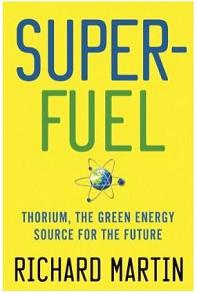
Superfuel by Richard Martin

Richard Martin, like many in the Thorium renaissance, is a believer in global warming and sees nuclear power as a way of supplying the world’s base load requirements for energy without adding to global climate change. Furthermore he is clear that the existing first generation of nuclear plants is unsafe and needs to be replaced by inherently safe designs.  He was one of the first journalists to promote thorium in his article in Wired magazine in late 2009.

When you write a book you should always be clear who you are writing it for.  In my view "Superfuel" is not written for the general public.  They would probably find it difficult to follow the vocabulary and the concepts of the nuclear industry, which he doesn’t hesitate to use with little explanation.  Furthermore Martin is a journalist, who uses many words where pictures would be easier to understand, but in "Superfuel" he has included only four diagrams and trying to explain the “Travelling Wave Reactor” in Chapter 8 without a diagram is bound to fail.  

So if he’s not writing to persuade the non-technical public to support the use of thorium and liquid fluoride reactor technologies, does he succeed in developing his argument for the nuclear cognoscenti or even an amateur like me with an engineering background?

Well, yes and no.  His account is superficial and lacking in solid technical detail about his main proposition, thorium fuelled liquid fluoride reactors (LFTR’s).  Aspects of the design that I questioned and needed to understand are not covered, like the treatment of the waste stream and the toxicity of fluorides. There isn’t even a photograph of the Oak Ridge Molten Salt Reactor Experiment to give substance to his frequent assertions about its pioneering advantages.

“Superfuel” also has numerous errors.   For example on page 195 he states “After the Fukushima-Daiichi accident, there was a brief run on supplies of iodine-131. An isotope of iodine produced in specialised reactors, iodine-131 is used to prevent thyroid cancer from radiation exposure.”  In fact it’s potassium iodide which is used to saturate the thyroid gland with iodine and lower the risk of uptake of radioactive iodine-131.

Other examples include stating that Toshiba “is Korean-owned” when it is in fact Japanese.  That, “xenon poisoning” was discovered at the X-10 reactor at Oak Ridge when it was actually first discovered at the Hanford “B” reactor in 1944 and its strongly neutron absorbing properties were easily overcome by adding more fuel rods.
It’s what you would expect from an educated journalist and not a scientist or engineer, so a member of the existing nuclear industry (who Richard Martin labels “the nuclearati”), unfamiliar with liquid fuelled reactors, would never be persuaded.
Where he is at his best is when he does his job as a professional journalist, investigating, sifting the facts and then telling the story, such as in his account of the history of the reasons why the development of civilian nuclear energy went exclusively in the direction of the uranium/plutonium fuel cycle.  More specifically how the light water reactor, with its inherent risk of explosion and release of radioactive materials, came to dominate the commercial market for nuclear power plants. Even here though he is very black and white about the personalities involved and makes little attempt to present a balanced view of, for example, Admiral Hyman Rickover and his achievements or Milton Shaw, who was a pivotal figure in the Atomic Energy Commission when the decision was taken to cancel molten salt reactor research.
Where he has done detailed research such as in chapters 7 and 9, he has turned up organisations and personalities that are retiring and secretive, such as Hector Dauvergne and George Langworth  who did not show up when I did an internet trawl concerning the development of Thorium power for an article that I wrote in September 2011.
In chapter 7 Martin considers the Asian context for nuclear power, and this is also well researched, although clearly access to detailed information sources and policy makers in China has been extremely limited until recently.  India has a huge energy requirement and should be a good candidate for nuclear innovation, but based on the operating performance of their nuclear industry, as quoted in “Superfuel”, they seem to be unable to successfully run their existing nuclear plants, so they cannot be considered as serious candidates to develop LFTR’s.  

Like India, China has a similarly overwhelming need for new energy sources, they have the political conditions for taking risks and they’re not hamstrung by the attitudes arising from 60 years of operation of traditional conventional uranium plants.  They have a highly disciplined technical workforce and experience of stringent quality control.  Furthermore, their regulatory framework is undeveloped compared to the West, and objections are likely to be ignored in the wider public interest.  Finally they have more than enough money to spend!
In Chapter 10 “What we should do?” Martin sets out a plan, from a distinctly US viewpoint, giving ways to fund and conduct a thorium power development programme.  He has researched the numbers and what he proposes would not have been impossible to achieve in a confident US of the 1940’s, 50s or 60’s.  But the US is now a very different country, politically polarised, saddled with a huge and still growing national debt and facing a serious crisis after the next election when they will have to begin to balance the books.   I agree with Richard Martin’s conclusion that China will be the first country to commercialise LFTR technology and, after establishing valid patents, will probably sell it to the West at a price that won’t be matched by any development programme which is started later than theirs!
We can, however, still hope for a breakthrough for Kirk Sorensen with the US military.

Monday, 9 July 2012

What's Funny About Thumbs?

Sixteen days ago I did something stupid and tried to move a deck chair while I was still sitting in it.  It collapsed and the top joint of my left thumb was trapped where the the two parts of the frame are articulated.  After having extracted it and, following a short period of silent screaming, it was clear that a trip to the emergency department of the local hospital was necessary.  The nail was flapping about and there was a lot of blood!


I had to wait a long time before seeing a doctor and was then sent for an X-ray.  When he came back, and looked at the fracture in the top joint, he said “Hmmm, what to do?  Hmmm, 63 years old!“ and disappeared.  The kindly nurse said “he’s gone to get advice”! When he came back he'd decided to stitch the nail back on and sew up the split flesh at the base of the nail.  There were six stitches in all.
  
The throbbing over the next two days and nights was intense.  
Sixteen days later, after ten days of antibiotics,litres of betadine (an iodine based antiseptic) and numerous dressings, the orthopaedic surgeon has just said that I can have the last two stitches, which are still holding the nail in place, taken out next Monday.  Then I’m due to see him again two weeks later.  He decided a fortnight ago that it didn’t need a pin to hold the two pieces of bone in place, and I assume it was him who advised the duty doctor in casualty that the thumbnail would act as a splint to hold the bones together.


Throughout all this even my nearest and dearest would say that I have been stoic and resolute, except when some people find the whole episode funny!  Then I get annoyed and tend to over-react by describing in detail the nature of the injury and the semi-circular shape of the suture needle which was used to sew the nail on.  In one case I showed the person concerned the blood which is still on the frame of the deck chair!


I don’t know what’s funny about men hurting their thumbs but it’s clear that about half of my female acquaintances think it is!  Does anyone know why?

Thursday, 28 June 2012

Ludi’s Cannon

When you have a three year old who lacks for nothing what do you give him for his birthday?

If, like Quince, you have the time, patience and skill, it’s obvious, you make him a cannon!
He already has a tiny one, which he loves playing with, so this one needed to be big, safe and not capable of trapping little fingers, or shooting things into people’s eyes.

It’s made from plywood and plastic pipe and fires tennis balls using an elastic band.
He’s going to have it on Saturday morning.


Wednesday, 13 June 2012

Puffins and Wood Warblers in West Wales

To recover from the first week of a strenuous visit to the UK, which involved sleeping in five different peoples’ houses, and three nights camping in the woods in West Wales, by unwinding in a couple of Welsh nature reserves on the way to Manchester was a good idea. 

Skomer
Skomer is an island off the coast of Pembrokeshire which, in early summer, is home to large colonies of breeding birds estimated at a total of 330,000, including 12,000 puffins, 60,000 manx shearwaters, 17,000 guillemots, razorbills, kittiwakes, fulmars and various gulls.  Manx Shearwaters are difficult to see. They stay out at sea during the day and only return to their burrows on dark nights when the risk of predation by greater black-backed gulls is low.  It is possible to stay overnight on the island and witness their weird calls as they locate their mates at the nest, there is, however, a long waiting list.

But it’s the puffins that are so charming!  They are really fearless and will tolerate you being only a couple of metres away as they fly to and from their nest burrows.

Thanks to Paul Hillion for the video which was taken at The Wick on Skomer.

This BBC2 video has some very good sequences of puffins fishing and pufflings, (young puffins).


Although puffins are quite capable of landing elegantly on the cliffs, I love the way they land on the sea.  They seem to prefer plopping into the water, as if they haven’t quite mastered the touchdown.  The effect is very comical!

Ynys Hir
Near Machynlleth is an RSPB reserve called Ynys Hir  known for its many pairs of nesting pied flycatchers and also for the wood warblers which can be heard in its mature oak forests.  After having been enchanted by them on my first visit in the 80’s I wanted to hear them once again.  The weather was against us since it was raining heavily but finally we found one which was singing in full view.  I was so pleased not only to hear but also to see one!


Thanks to  Paul C King of the Bradford Ornithological Group for the video

Wales is known for its rain and the visit would have been even better without it, sometimes it was raining horizontally!  The day after we left Mid-Wales there was 5 inches of rain overnight and major flooding!

Wednesday, 16 May 2012

Golden Orioles in Gagnac

In the last two weeks there has been a pair of male Golden Orioles calling from the woods across the valley.  I have yet to see them and they don’t seem to call every day.  Perhaps they sing only in warm weather but they have been spotted not far away having a fight in the trees. Confusingly the french word for Oriole is Loriot (you don't pronounce the t).

The male is striking in the typical oriole black and yellow plumage, but the female is a drabber green bird. Orioles are shy, and even the male is remarkably difficult to see in the dappled yellow and green leaves of the canopy.  There are very few good videos of them on Youtube.
I wasn’t aware that they are in this part of France but this  Wikipedia article states that their breeding range extends from Portugal, Spain and France across the United Kingdom and Scandinavia to Poland, Russia, the Balkans, Turkey and West Asia to the Caucasus up to Mongolia and China. They winter in central and southern Africa. They generally migrate during the night, but may travel during the day in the spring migration. During the fall migration they migrate via the Eastern Mediterranean where they feed on fruit; they are often considered a pest in this region because of this.

Their call is a screech like a jay, but the song is a beautiful fluting weela-wee-ooo or or-iii-ole, unmistakable once heard. It carries a long way and this morning one could be clearly heard in the distance.


The Eurasian Golden Oriole inhabits a range of habitats. In Western Europe they prefer open broadleaf forests and plantations, copses, riverine forest, orchards and large gardens; in Eastern Europe they may inhabit more continuous forest as well as mixed or coniferous forests. They generally avoid treeless habitats but may forage there. In their wintering habitat they are fond in semi-arid to humid woodland, tall forests, riverine forest, woodland/savanna mosaic and savanna.
They feed on insects and fruit. They build neat nests in tree forks and lay 3-6 eggs.
I hope that they keep coming back to Gagnac.

Thursday, 8 March 2012

Thorium Makes the Mainstream Media

BBC Series - Costing the Earth

Nuclear Power without the Nasties? 28 Feb 2012 http://www.bbc.co.uk/podcasts/series/costearth 
Kirk Sorensen
It’s really gratifying to see the subject of thorium fuelled nuclear power begin to penetrate the mainstream media.  I downloaded the podcast of this half hour BBC programme and listened to it yesterday.  The researchers and editors have done a very competent job; it’s an excellent piece of journalism and captured the subject very well in all its aspects, but without delving too far into the detail.  Kirk Sorensen was interviewed and, amongst other topics, gave a very lucid account of the reasons why the Oak Ridge Molten Salt ReactorExperiment (MSRE) was closed down in 1969.

Environmentalists for Thorium

Baroness Bryony Worthington
Others also interviewed were Michael Childs, of Friends of the Earth, and Baroness BryonyWorthington, who used to campaign for them.  They were correctly presented as environmentalists enthusiastic about thorium nuclear technology.  

Michael Childs
The ending was particularly striking.  It accurately relayed the scepticism of the nuclear establishment in the UK concerning thorium, and contrasted it with the optimism of Michael Childs and Baroness Bryony Worthington. Wouldn’t it be highly ironic if a significant proportion of environmentalists were calling for work to start on thorium based nuclear power, whilst the nuclear establishment were blocking research funding?  Personally I think that’s what’s very likely to happen in Europe.  Michel Allibert of the Reactor Research Group at Grenoble also highlighted the regulatory difficulties in the podcast.  In the US I’m a bit more optimistic, because it appears that Kirk Sorensen has a plan to get around these issues, but the same conservatism and regulatory forces are still present.  

Is the future Chinese?

In my opinion, the country which will fund and develop research into LFTR’s (Liquid Fuelled Thorium Reactors) and build the first commercially viable reactor will most likely be China.  They have an enormous growing need for energy and no constraints on regulatory compliance.  They also have the money and are rapidly developing the expertise.  For years they’ve been raiding the archives at the US’s Oak Ridge National Laboratory, the place where the original research was done in the sixties by Alvin Weinberg.  I’ve read some of the old Oak Ridge papers and Alvin Weinberg ran a tightly managed organisation. Everything was documented and reported, including their setbacks and problems.  
It’s a gold mine for English speaking Chinese researchers! They topped the visitors list in 2009 and 2010. 

In 2009 :-

1. China (1,139)
2. India (569
3. Germany (478)
4. United Kingdom (420)
5. Japan (408)
6. South Korea (363)
7. Canada (310)
8. Russia (258)
9. France (250)
10. Italy (105) 


“Once again, in 2010, China was the biggest source of foreign visitors to Oak Ridge National laboratory - accounting for more than 20 percent of the total number of foreign visitors and more than twice as many as any other country.

1. China (1,522)
2. India (709)
3. Germany (631)
4. United Kingdom (536)
5. Japan (498)
6. Canada (476)
7. South Korea (452)

 According to information provided by ORNL's Laboratory Protection Division, the number of foreign visitors processed last year was 7,487. That's up significantly from 2009 (6,007), which, in turn, was up from 2008 (5,092). There's obviously a growth pattern.

This is at least the sixth year in a row that China has headed the foreign visitors list, and it's probably been even longer. The lab did not have historical statistics readily available.”

France 2
There was also a short report which dealt with the subject of thorium on the national news on France 2 on 29th January (in French). http://www.youtube.com/watch?v=DQ78iID1mF8  It ends rather pessimistically with the scepticism of the nuclear establishment coming through loud and clear.  

Minimising Thorium’s Advantages

In spite of the fact that the Oak Ridge MSRE reactor ran successfully from 1965 to 1969,  today’s “industry experts” both in France and in the UK are still saying that pumping high temperature molten salts at atmospheric pressure is difficult and dangerous.  (But almost certainly not as dangerous as containing and pumping high pressure water, with a potential for loss of coolant and subsequent explosion risk, which has already happened at Three Mile Island, Chernobyl and Fukushima).

The current stance of such experts is “It’s likely to be difficult and take a long time so it’s better to do nothing”, they minimise the advantages of Liquid Fuelled Thorium technology, and ignore the historical reality of a reactor that functioned for 4 years at Oak Ridge.

What a wonderful illustration of the decadence of Western European society which has lost the capability to invest, to take risks and to innovate!