Saturday, 26 September 2020

Is it time we learned to live with the virus?

When the Covid 19 virus first appeared almost everyone was unprepared. Some governments like China, South Korea and Germany did better than others; they reacted quickly and took control. The result was that they had fewer cases, fewer people with serious illness, fewer deaths and less severe economic effects.  Other states like Italy, Spain, the UK and France had leaders who were slower and less capable of reacting to the situation before they had a severe outbreak resulting in tens of thousands of deaths. Still others, like the leaders of the USA and Brazil, refused to take the disease seriously and actively attempted to minimize its impact and consequences. In some cases this was in spite of their knowledge of the true facts. They preferred to prioritize the politics of the pandemic rather than listen to their scientific advisers and we can now see the results of that in death rates.

Following the example of China, Western governments almost universally instituted drastic confinement measures to slow down the transmission of the virus and prevent a situation in which hospitals were overwhelmed and people were dying on stretchers in car parks. On the whole and despite the high number of deaths this was a qualified success. It reduced infections drastically and people did comply with the draconian restrictions, in spite of the very severe economic consequences.

The second wave.

Then, as the virus declined in Europe in the summer, we all relaxed and started mixing normally, crowding onto beaches and having parties. So of course the virus came back and is now circulating freely and reproducing exponentially in many places, including France and the UK. Whilst infection rates are high, death rates are low at the moment, but they will increase after a lag period of a few weeks.

Fortunately, and although it is less than perfect, as a result of the increased availability of testing we now know much more than we did before about the geographical spread of the virus, and can identify hotspots where infections are spreading more quickly than in other areas. This allows politicians to try a more graduated and localized response. It remains to be seen whether recent relatively minor restrictions, like restricting social events and closing pubs and bars at 10pm will make any difference. It should be said that the rate of testing is very much higher than it was in March and April and so many more active infections are now being identified and reported.

Whilst the UK government appears to be reacting on the hoof to day to day changes and not communicating clearly, France has set out an alert system, based on infection rates, which will trigger progressive local restrictions decided by the Prefecture of each Department. At the same time, under their new Prime Minister Jean Castex, they seem to be downplaying the extent of the rise in infections and prioritizing keeping open schools and the economy.


Is it time we learned to live with the virus? 

In my opinion that's exactly what we are in the process of doing now, and only time will tell if less restrictive measures than were applied earlier in the year will be effective. So what is there still to debate?

Some people resent the restrictions on their freedoms to circulate freely and carry on as before. Others are very cautious about social mixing. Some people deny the existence of the virus altogether! Still others are concerned about the damage done to individuals and the economy by movement restrictions and lockdowns.

An impossible balance.

In my view the choice between voluntary or compulsory measures comes down to politicians attempting to strike an almost impossible balance between the needs of individuals to maintain their freedoms; the need to allow economic activity to continue; and the need to protect vulnerable people at greater risk of severe illness or death. Also let’s not forget that even young and fit people can find themselves incapacitated and unable to work months after overcoming the original infection, the so-called Long Covid.

It is the mindset of the individual which determines whether they value their own freedoms to such an extent that helping others to stay clear of infection by accepting constraints is much less important to them. Individuality versus Solidarity. In consequence there will always be people who are dissatisfied with any restrictive measures that are imposed or who consider that they have not been taken early enough.

Striking this balance also concerns the perception and evaluation of risks, about which most people are highly irrational. I’m glad that I’m not a politician charged with the task of weighing all these considerations. Sometimes I almost feel sorry for them, but not for long!

I have no time whatsoever for people who deny the existence of the virus altogether and prefer to believe in a worldwide conspiracy theory to explain the deaths and testimony of victims. Unfortunately there is a significant number of them!

Lockdown versus freedom and a thriving economy

Presenting free movement and lockdown as alternative responses to the pandemic is, however, a false comparison. I don’t think that a nation can have a functional and thriving economy in a situation where a dangerous illness is circulating freely. People will seek to avoid and minimize their risks by working from home; by not using public transport; by not going to concerts, the theatre or restaurants; and by stopping unnecessary shopping trips and travel. Various sectors of the economy, and their employees, will suffer severely as a result. This is continuing to happen even though lockdown was lifted long ago.

The Swedish example.

The experience of Sweden, which with some restrictions kept everything open, can be quoted to deny this viewpoint, but Sweden is a country with a high standard of living. It’s not overcrowded and has notoriously reasonable inhabitants who have a high level of trust in their government. It’s very different from the overcrowded cities of Southern Europe, South America or India. Even so up to the 22nd September 2020 Sweden had a total number of deaths of 5,877 for their 10.23 million inhabitants compared with a total of 1,253 for their neighbours Norway, Finland and Denmark who have a combined population of 16.76 million and followed a lockdown policy. Is that a success? I suppose it depends on what value you put on human lives compared to economic losses.

Conclusion

In my view, both from a health and an economic standpoint, it’s in everybody’s interests to reduce the circulation of the virus. So if that means accepting restrictions on my freedom to travel and socialize that's fine with me!

Roll on the availability of an effective vaccine!


Tuesday, 24 September 2019

Unanimous Supreme Court decision against Johnson


Image result for lady Hale supreme Court
Lady Hale President of the UK Supreme Court

R (on the application of Miller) (Appellant) v The Prime Minister (Respondent) Cherry and others (Respondents) v Advocate General for Scotland (Appellant) (Scotland)
On appeals from: [2019] EWHC 2381 (QB) and [2019] CSIH 49

JUSTICES: Lady Hale (President), Lord Reed (Deputy President), Lord Kerr, Lord Wilson, Lord Carnwath, Lord Hodge, Lady Black, Lord Lloyd-Jones, Lady Arden, Lord Kitchin, Lord Sales


In giving the judgment of the Court Lady Hale said:

We have before us two appeals, one from the High Court of England and Wales and one from the Inner House of the Court of Session in Scotland. It is important, once again, to emphasise that these cases are not about when and on what terms the United Kingdom is to leave the European Union. They are only about whether the advice given by the Prime Minister to Her Majesty the Queen on 27th or 28th August, that Parliament should be prorogued from a date between 9th and 12th September until 14th October, was lawful and the legal consequences if it was not. The question arises in circumstances which have never arisen before and are unlikely to arise again. It is a “one-off”.

Briefly, the Scottish case was brought by a cross party group of 75 members of Parliament and a QC on 30th July because of their concern that Parliament might be prorogued to avoid further debate in the lead up to exit day on 31st October. On 15th August, Nikki da Costa, Director of Legislative Affairs at No 10, sent a memorandum to the Prime Minister, copied to seven people, civil servants and special advisers, recommending that his Parliamentary Private Secretary approach the Palace with a request for prorogation to begin within 9th to 12th September and for a Queen’s Speech on 14th October. The Prime Minister ticked ‘yes’ to that recommendation.

On 27th or 28th August, in a telephone call, he formally advised Her Majesty to prorogue Parliament between those dates. On 28th August, Mr Jacob Rees-Mogg, Leader of the House of Commons and Lord President of the Privy Council, Mr Mark Harper, chief whip, and Baroness Evans of Bowes Park, Leader of the House of Lords, attended a meeting of the Privy Council held by the Queen at Balmoral Castle. An Order in Council was made that Parliament be prorogued between those dates and that the Lord Chancellor prepare and issue a commission for proroguing Parliament accordingly. A Cabinet meeting was held by conference call shortly after that in order to bring the rest of the Cabinet “up to speed” on the decisions which had been taken. That same day, the decision was made public and the Prime Minister sent a letter to all Members of Parliament explaining it. As soon as the decision was announced, Mrs Miller began the English proceedings challenging its lawfulness.
Parliament returned from the summer recess on 3rd September. The House of Commons voted to decide for themselves what business they would transact. The next day what became the European Union (Withdrawal) (No 2) Act passed all its stages in the Commons. It passed all its stages in the House of Lords on 6th September and received royal assent on 9th September. The object of that Act is to prevent the United Kingdom leaving the European Union without a withdrawal agreement on 31st October.

On 11th September, the High Court of England and Wales delivered judgment dismissing Mrs Miller’s claim on the ground that the issue was not justiciable in a court of law. That same day, the Inner House of the Court of Session in Scotland announced its decision that the issue was justiciable, that it was motivated by the improper purpose of stymying Parliamentary scrutiny of the Government, and that it, and any prorogation which followed it, were unlawful and thus void and of no effect. Mrs Miller’s appeal against the English decision and the Advocate General’s appeal against the Scottish decision were heard by this court from 17th to 19th September. Because of the importance of the case, we convened a panel of 11 Justices, the maximum number of serving Justices who are permitted to sit. This judgment is the unanimous judgment of all 11 Justices.

The first question is whether the lawfulness of the Prime Minister’s advice to Her Majesty is justiciable. This Court holds that it is. The courts have exercised a supervisory jurisdiction over the lawfulness of acts of the Government for centuries. As long ago as 1611, the court held that “the King [who was then the government] hath no prerogative but that which the law of the land allows him”. However, in considering prerogative powers, it is necessary to distinguish between two different questions. The first is whether a prerogative power exists and if so its extent. The second is whether the exercise of that power, within its limits, is open to legal challenge. This second question may depend upon what the power is all about: some powers are not amenable to judicial review while others are. However, there is no doubt that the courts have jurisdiction to decide upon the existence and limits of a prerogative power. All the parties to this case accept that. This Court has concluded that this case is about the limits of the power to advise Her Majesty to prorogue Parliament.

The second question, therefore, is what are the limits to that power? Two fundamental principles of our Constitution are relevant to deciding that question. The first is Parliamentary sovereignty - that Parliament can make laws which everyone must obey: this would be undermined if the executive could, through the use of the prerogative, prevent Parliament from exercising its power to make laws for as long as it pleased. The second fundamental principle is Parliamentary accountability: in the words of Lord Bingham, senior Law Lord, “the conduct of government by a Prime Minister and Cabinet collectively responsible and accountable to Parliament lies at the heart of Westminster democracy”. The power to prorogue is limited by the constitutional principles with which it would otherwise conflict.

For present purposes, the relevant limit on the power to prorogue is this: that a decision to prorogue (or advise the monarch to prorogue) will be unlawful if the prorogation has the effect of frustrating or preventing, without reasonable justification, the ability of Parliament to carry out its constitutional functions as a legislature and as the body responsible for the supervision of the executive. In judging any justification which might be put forward, the court must of course be sensitive to the responsibilities and experience of the Prime Minister and proceed with appropriate caution.

If the prorogation does have that effect, without reasonable justification, there is no need for the court to consider whether the Prime Minister’s motive or purpose was unlawful.

The third question, therefore, is whether this prorogation did have the effect of frustrating or preventing the ability of Parliament to carry out its constitutional functions without reasonable justification. This was not a normal prorogation in the run-up to a Queen’s Speech. It prevented Parliament from carrying out its constitutional role for five out of the possible eight weeks between the end of the summer recess and exit day on 31st October. Proroguing Parliament is quite different from Parliament going into recess. While Parliament is prorogued, neither House can meet, debate or pass legislation. Neither House can debate Government policy. Nor may members ask written or oral questions of Ministers or meet and take evidence in committees. In general, Bills which have not yet completed all their stages are lost and will have to start again from scratch after the Queen’s Speech. During a recess, on the other hand, the House does not sit but Parliamentary business can otherwise continue as usual. This prolonged suspension of Parliamentary democracy took place in quite exceptional circumstances: the fundamental change which was due to take place in the Constitution of the United Kingdom on 31st October. Parliament, and in particular the House of Commons as the elected representatives of the people, has a right to a voice in how that change comes about. The effect upon the fundamentals of our democracy was extreme.

No justification for taking action with such an extreme effect has been put before the court. The only evidence of why it was taken is the memorandum from Nikki da Costa of 15th August. This explains why holding the Queen’s Speech to open a new session of Parliament on 14th October would be desirable. It does not explain why it was necessary to bring Parliamentary business to a halt for five weeks before that, when the normal period necessary to prepare for the Queen’s Speech is four to six days. It does not discuss the difference between prorogation and recess. It does not discuss the impact of prorogation on the special procedures for scrutinising the delegated legislation necessary to achieve an orderly withdrawal from the European Union, with or without a withdrawal agreement, on 31st October. It does not discuss what Parliamentary time would be needed to secure Parliamentary approval for any new withdrawal agreement, as required by section 13 of the European Union (Withdrawal) Act 2018.

 The Court is bound to conclude, therefore, that the decision to advise Her Majesty to prorogue Parliament was unlawful because it had the effect of frustrating or preventing the ability of Parliament to carry out its constitutional functions without reasonable justification.

The next and final question, therefore, is what the legal effect of that finding is and therefore what remedies the Court should grant. The Court can certainly declare that the advice was unlawful. The Inner House went further and declared that any prorogation resulting from it was null and of no effect. The Government argues that the Inner House could not do that because the prorogation was a “proceeding in Parliament” which, under the Bill of Rights of 1688 cannot be impugned or questioned in any court. But it is quite clear that the prorogation is not a proceeding in Parliament. It takes place in the House of Lords chamber in the presence of members of both Houses, but it is not their decision. It is something which has been imposed upon them from outside. It is not something on which members can speak or vote. It is not the core or essential business of Parliament which the Bill of Rights protects. Quite the reverse: it brings that core or essential business to an end.

This Court has already concluded that the Prime Minister’s advice to Her Majesty was unlawful, void and of no effect. This means that the Order in Council to which it led was also unlawful, void and of no effect and should be quashed. This means that when the Royal Commissioners walked into the House of Lords it was as if they walked in with a blank sheet of paper. The prorogation was also void and of no effect. Parliament has not been prorogued. This is the unanimous judgment of all 11 Justices.

It is for Parliament, and in particular the Speaker and the Lord Speaker to decide what to do next. Unless there is some Parliamentary rule of which we are unaware, they can take immediate steps to enable each House to meet as soon as possible. It is not clear to us that any step is needed from the Prime Minister, but if it is, the court is pleased that his counsel have told the court that he will take all necessary steps to comply with the terms of any declaration made by this court.

It follows that the Advocate General’s appeal in the case of Cherry is dismissed and Mrs Miller’s appeal is allowed. The same declarations and orders should be made in each case.

NOTE: This summary is provided to assist in understanding the Court’s decision. It does not form part of the reasons for the decision. The full judgment of the Court is the only authoritative document. Judgments are public documents and are available at: www.supremecourt.uk/decided-cases/index.html

Sunday, 7 October 2018

Boris does his best Boris tribute act for the Tory conference


Bumbling, hair tugging and lectern thumping all feature in Johnson’s greatest hits show

‘This was the golden ticket. A message of hope for the hopeless.’
 Photograph: James McCauley/Rex/Shutterstock

Say what you like about Boris Johnson, he delivers a second-rate speech better than most other second-rate politicians, many of whom have been on show at the Tory party conference in Birmingham this week. But the bottom line is that Boris is essentially still second rate. A man who imagines himself to be a latter day Winston Churchill, but is nothing more than an ersatz Donald Trump with little to offer other than his own narcissism masquerading as cheap populism.

Yet in the land of the blind, the one-eyed man is king, and Johnson is what passes for stardust in the Brexit circles of the Tory party. A faint flicker, raging against the dying of the light, as he struggles to avoid being sucked into the black hole. And for his one scheduled appearance at a fringe event, hundreds of delegates were queueing outside the 1,500-seater hall some two hours before he was due on stage. This was the golden ticket. A message of hope for the hopeless.

Shortly before the start, the usual VIP suspects began to fill the front row. David Davis, Steve Baker, Priti Patel, Owen Paterson, Andrea Jenkyns, John Redwood and Andrew Bridgen. The same crew that had been at almost every “Chuck Chequers” event. None of whom most sane people would trust anywhere near government. The scene was set. This wasn’t going to be a serious speech so much as an act of communion for the already converted. A greatest hits rally at which Boris would deliver his own Boris tribute act.

Johnson bumbled on to stage. Bumbling was what people expected of him – his trademark trope – and he didn’t want to disappoint. The audience rose to give him their first standing ovation and he relaxed a little. He still had the magic. “It’s great bumble bumble to be bumble bumble in Birmingham bumble bumble,” he bumbled, before insisting that he was standing before everyone “with all humility”. Always good to get the first lie in early. Boris has never done humble in his life.


 'Chuck Chequers': Boris Johnson attacks Theresa May's Brexit plan – video

After that he was straight on to autopilot. A lot more bumble bumbling, a bit of hair tugging and the occasional thump of the lectern to suggest he actually cared about what he was saying. Pretty much the same speech he had given the time before and the time before that. The same feeble gags about Toblerones and bus shelters that never failed to get a few desultory laughs from people starved of genuine humour. The same sob story about how he had once felt sorry for a couple in a Wolverhampton council house. The same lies about things the EU had never done and what the Labour party planned to do. Always the lies.

Bumble bumble. Loud whoops from the audience. Bumble bumble. The same broken record of why Boris thought that Boris would make a great prime minister and couldn’t believe that the whole world didn’t agree with Boris. He ran through a totally uncosted housing programme; he did a drive-by shooting of Michael Gove; he boasted of his record as foreign secretary. That last bit didn’t take long.

Then Boris turned his attention to Theresa May and Brexit. Chequers was against the law – it wasn’t, but what the hell? – and Britain was being cheated. What was needed was someone like Boris who would bumble bumble, make Latin references, ruffle his hair and say that Britain could be great again if only we believed enough. Someone who lacked even the basic level of self-awareness to realise he had broken the system and had no real idea how to fix it. Someone whose only visible plan was to say sod off to the EU and that if it was very lucky we would let it trade with us again sometime in the future.

Same old, same old. A vision of the future in which Boris was prime minister and the country was condemned to a seventh circle of hell in which the same speech, the same jokes, the same Latin, would be played on a loop indefinitely. Then a rare moment of clarity. Pathos even. Boris looked down at the front row and saw just a handful of the same hopeful faces. He might have the numbers to stop Chequers, but he was way short of what he would need to become prime minister. His speech bumble bumble tailed off into silence. As so often, he had made a splash. But the waters would soon close over.

Reproduced, without permission, from an article by John Crace in the Guardian

Tue 2 Oct 2018 18.11 BSTLast modified on Tue 2 Oct 2018 21.05 BST

John Crace


Monday, 30 April 2018

Honesty in Politics


After weeks of clinging on Amber Rudd has finally resigned her post as Home Secretary! Her reason was that she inadvertently misled the Commons by denying that there were quotas for “illegal” migrants.

She should have also apologized for being incompetent and for supporting such outrageous policies in the first place.

Assuming that Rudd didn't know and approve of what was being done in her own department, soon after the stories in the press about the difficulties experienced by the Windrush migrants started to appear, anyone with an iota of humanity and empathy would have investigated and carpeted the Home Office civil servants concerned. To ask individuals who arrived as children to now prove that they have the right to live, work, rent a flat and get medical treatment in the UK or face deportation is outrageous. To set Kafkaesque requirements for documentation that officials know has been destroyed, or is impossible to obtain, such as to require four pieces of documentary evidence for each year since they arrived in the UK as children is preposterous, cruel and designed so that the applicant will fail to prove their right to remain. But Amber Rudd doesn’t seem to have any empathy, neither does Theresa May, whose policies to create a hostile environment for migrants, developed when she was Home Secretary, are at the root of the whole scandal.

But as well as being responsible for the formulation and application of such inhumane policies, both May and Rudd appear to be seriously lacking in the politicians’ basic skills of keeping in touch with public opinion and reacting appropriately. As late as two weeks ago May was refusing to see Commonwealth leaders to discuss the sorry affair!  They both thought that public opinion would back their hard line stance, but there is still a sense of decency left in the nation.

May demonstrated that she was out of touch with the real world during the last election campaign so I suppose that we should not be surprised that she continues to do so. As for Rudd, who was being touted as a future party leader, her performance has disappointed the more liberal wing of the Tory Party and outraged members of the public including myself. The current leaders of the UK, which was once known for its tolerance, justice and fair play are responsible for destroying that reputation with a series of badly conceived, populist and racist policies.

It’s time that May dropped her unrealistic immigration targets and admitted that her policies are misguided and their execution cruel. The Brexiteers' lies about migrants and tabloid hysteria; together with genuine concern about the pressure on public services caused by savage Tory spending cuts on schools, the NHS, local authorities and their social care budgets, have created the conditions for May’s "hostile environment" policies. History has shown us that it’s always easy to blame foreigners, or people with a different skin colour or religion, for your own home-grown problems: but it's not too late for some honesty in politics and a new more humane way forward for the Tory party. Otherwise the tag line “The Nasty Party” will stick to them until the next election!

Sunday, 17 September 2017

Boris Johnson the Liar is Still Lying


Apart from his over-inflated ego, Johnson’s habitual lying is his most persistent character trait. Like Trump he really seems to live in his own post-truth world or perhaps, as Chris Patten says in this BBC interview, he can't tell the difference between fact and fiction. Nevertheless if you repeat a lie that many people want to believe often enough, some of them, who are happy to have their prejudices reinforced, will believe you and you have created a new factoid.

Boris Johnson is still lying about sending £350 million a week to Brussels. He is ignoring the rebate that Thatcher negotiated. This reduces the amount actually sent to Brussels to £240 million per week. Then the EU pays back £5.8 billion/yr into the UK in the form of subsidies, regional aid and support for scientific research. This reduces the net amount paid to the EU to £136 million per week, still a significant sum but until brexit we get unfettered access to the EU's markets in exchange. But if you’re Boris Johnson, pitching a leadership bid to the Tory right wing, then you can ignore all that, can’t you! After all, his lies won him the Leave votes that he needed to validate all the false anti EU stories that he wrote whilst he was a journalist.

Does he really believe that he could run the country? He must have recovered from the fear that showed on his face after the referendum result. But then if you live in a post-truth world you can believe anything you choose, especially if you're Boris Johnson and you lie to yourself!  However, having been let off the hook as the potential Prime Minister by his erstwhile friend Michael Gove stabbing him in the back, he was rewarded with the post of Foreign Secretary, and his clownish gaffes and bumbling incapability have elevated him to legendary status among world political leaders. 


Boris Johnson is an international joke, but a potentially dangerous one! Faced with a very weak Theresa May, who daren't sack him, he could yet become leader of the Tory Party and hence Prime Minister.


Wednesday, 26 July 2017

All Electric Cars by 2040?


The man who said "who needs experts" is still inventing new ways to mislead the public. Michael Gove, as Environment Secretary, has announced that from 2040 the UK will ban the sale of non-electric cars and vans. This is following France who made a similar announcement some weeks ago.

Thankfully Gove will be long out of office by 2040 but the planning needs to start now. 

Putting aside the criticisms that this does not address the immediate air pollution problems in our cities, it all sounds fantastic until you look below the surface spin! I wonder if Amber Rudd (Secretary of State for Energy and Climate Change) and her civil servants have done the calculation below, which shows that we would need to build between 3 and 7 new power stations every year from 2020, in order to supply the demand from charging electric vehicles. Is that going to happen? Did Gove ask her opinion?

We would also need to build a publicly accessible charging infrastructure and improve the energy density of batteries and their longevity significantly. At the moment the typical range of an all electric vehicle is about 100-200 miles and battery packs last 5-8 years. Since they are very expensive to replace this is important, especially for the used car market.

In cities, where there's nowhere to park cars except on the highway, I don't see how owners will be able to charge them. Are we really talking about kerbside charging points every two car lengths? In Islington, where I used to live in the 1990's, the local vandals would have fun collecting the plugs and cables for scrap!

I'm in favour of reducing air pollution, and maybe even reducing the carbon dioxide generated by road transport by using renewables and nuclear instead of fossil fuels to generate the electricity. It could all be done if there was a real political will behind it, but to achieve this transition by 2040 needs some funding and sustained joined up thinking across government departments. I don't know whether you've seen much of either recently but I haven't, certainly not from Michael Gove and his erstwhile friend Boris the liar!


45,000,000,000
l/yr
34
1 US gallon is 3.785 litres
3.785
l /US gallon
so to replace all road fuel would need
400,660,501,982
kWh/yr
or per day
1,097,700,005
kWh/d
or an average instantaneous demand of
45,737,500
kW
or
45,737
MW
allow double for peak load
91,474
MW
700
MW
so it would need this many new power stations
131
or over 20 years
7
per year

Thursday, 20 July 2017

Options for Tackling Climate Change


Dear Michel,
In a brief conversation the other day you expressed the commonly held view that nuclear power is unacceptable due to the very long-lived waste that it creates. I anticipate that you are also concerned about safety and the risk of contaminating the environment as a result of a release of radioactive material. I don’t have sufficiently good French to sustain a discussion on this complex issue, which is also for many people a very emotional topic leading to stormy arguments, and so I said little or nothing, but I've finally decided that I wish to express my views on the subject. 

Climate Change - Conservation is not Enough
I’m sure that we can both agree that climate change is the single most serious challenge facing the world today. The question is: what is the best way of tackling the problem of rising energy demand, and demand for electricity in particular, at the same time as limiting the emission of man-made greenhouse gases, principally carbon dioxide? 

Whilst we can make some progress within developed economies by improvements in efficiency, conservation and demand management, the net result of these measures will be grossly insufficient to counter the legitimate requirement for more energy from developing economies. In this video “The Magic Washing Machine” by Hans Rosling (now sadly deceased) he explains why we in the developed world have no right to tell people in developing economies that they can’t use more energy because of Climate Change.


The Role of Renewables
So as well as conservation measures what is the best way forward?  Clearly renewables have a significant part to play in the future of energy production, and they are getting cheaper, but they are still being subsidized and, in common with other energy production technologies, they are not without an impact on the environment.

For example land area. Electricity generation from wind and solar energy is based on diffuse energy sources and is consequently land hungry. The graphic below illustrates the areas required for different energy generating sources for a capacity of 1000MW (1GW). The units are in square miles. To generate 1GW from wind would require about 300 square miles and from solar about 60 square miles.

In contrast nuclear power plants, and those using fossil fuels, are burning energy dense substances and so require only about 1 square mile. In terms of area, a gas fired plant would be comparable with a nuclear power station and a coal fired plant would be a little bigger due to the space required for stockpiling coal and ash.
In Europe, where most non-urban land is already farmed, I question the overall viability of covering fields with solar panels. Near us, in South West France, there is an application to do just that on an area of land that we visit each Spring to hear nightingales and look at orchids.

Variability of Wind and Solar
Depending on location, wind power installations are normally expected to produce electricity 30-50% of the time.  Their output is variable over both short and long term timescales and also by geographical situation. The latter can be an advantage since a diversity of locations can result in a degree of smoothing of output power levels.

On dull overcast days solar photo voltaic power can be largely unproductive, especially in northern latitudes. So when demand peaks on cold winter evenings when there is no sunlight, if there is also no wind, both solar and wind generators will not supply power.

Solar panels produce most efficiently in hot sunny places, like sparsely inhabited deserts.  In certain locations, if geo-political constraints involving distance and international borders can be overcome, it may be an economic proposition to generate solar power in one country and transfer it to another. Long transmission lines,with their associated costs and losses (in the USA in 2007 transmission losses were estimated at 6.5%), would then be needed to deliver the power to centres of population. 

High Voltage DC lines have been used in some long distance situations. These have the advantage that the capacitance of the line and hence its charging current is no longer a length limiting consideration as it is with alternating current systems. One of the disadvantages is that DC voltages cannot be easily reduced by transformers without first utilising inverters, with their associated costs and efficiencies, to recreate alternating current.

So both solar and wind power are, by their nature, highly variable and cannot provide continuous reliable output. In almost all electricity supply grids there is no significant storage capacity so, to meet the demand from consumers, electricity utility operators therefore have to schedule the right mix of flexible and inflexible power generation capacity from different types of generators. As part of the day to day management of the grid, this requires them to predict the weather conditions and hence the output from renewables. If there is an unpredictable drop in output from renewables, then flexible generation capacity must be quickly brought on line. Electricity from flexible sources commands a much higher price in wholesale electricity markets than that from inflexible base load plants, so getting this right is therefore important for both utility companies and consumers. This paper from the US National Renewable Energy Laboratory explains the problem in detail. 

If, as in Germany, there is a law forcing utilities to accept energy from renewables as a priority then, as the proportion of total generating capacity that wind and solar power provide increases, there will be an increasing need to maintain backup power supplies with their associated costs and energy consumption. If not the system would become unstable and power cuts would result.

In effect without grid scale energy storage, to satisfy the demand when renewables can't, there will be a limit to the proportion of electricity production that can be provided by these sources. So what options are available for large scale energy storage?

Energy Storage
There are many ways of storing and recovering energy. For electricity the one we are most familiar with is the use of batteries.

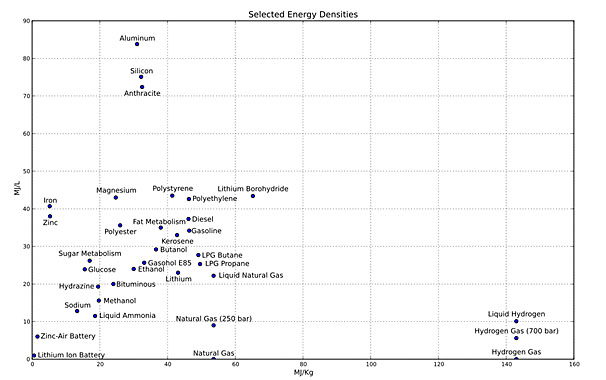
The following graphic, which plots energy density in MJoules/litre against MJoules/kg, puts into context the energy density of Lithium Ion and Zinc-Air batteries relative to other substances. The significance of energy density is that gasoline, for example, effectively stores about 50 times more energy per kg than lithium ion batteries and so is much more portable. 

Battery storage technology is developing slowly; but current batteries are still expensive, have low energy densities and a limited life. In my view both energy density and longevity would need to improve by at least one or possibly two orders of magnitude before the use of batteries to smooth out variable production from renewables would become economic on a grid scale.


Other energy storage systems are being proposed and investigated, and some may be promising in the long term, but most are not yet proven to be economically viable or available for widespread deployment. 

Generation of Hydrogen
An interesting example is the proposal to use surplus energy generated by wind and solar, that is not required by the grid, to create hydrogen which can be stored until it is used to generate electricity during periods of low output from renewables. The difficulty with this concept is its overall efficiency. The efficiency of electrolysis is 60-70% and the ongoing conversion back into electricity is 40-60% (depending on the method used). Thus the overall efficiency of the round trip is 24-56%, which is much lower than batteries, and there is also the energy cost of compressing or liquefying the gas but, providing there are periods of overcapacity of installed renewable generation, the electricity used is effectively free. There are many possible means of implementing such a scheme and there are also other uses for hydrogen such as in powering vehicles. Work is ongoing to establish its overall economic viability.

Liquid Air Energy Storage
A further method which is getting serious consideration and development is the use of liquid air as an energy storage medium. Similarly to the production of hydrogen, electricity production from wind and solar is used to liquefy air at atmospheric pressure and when required it can be evaporated under pressure to drive generators. A 5MW/15MWh demonstration plant, constructed by Highview Power, has been in operation since 2018 at Pilsworth, Bury, UK.  Construction has started on an £85m project at Trafford Energy Park, Manchester, UK, which is due for completion in 2022 and will store 250 MWh of energy. The round trip efficiency of such systems is low at around 25% but this can be enhanced with the use of a cold store to 50%. If the facility is located near a source of waste heat like an industrial process or thermal power generation system, the efficiency can be further enhanced, and Highview Power claims 70%, without the need to augment the capital cost with heat recovery systems.

Electric Vehicles
Another example is the idea that, when required, electricity could be fed back into the grid from the batteries in electric vehicles: and therefore at some future date a large battery storage capacity would be available to smooth out shortfalls between generating capacity and demand. Although this concept is now being marketed by Nissan and Ovo, it's unclear how it would be managed on a large scale, but it would probably need an infrastructure that had connection points at the majority of parking places; as well as some form of smart metering that credited the vehicle owner if stored electricity, that had already been paid for, was drawn out of the vehicle's batteries. These connection points, or the vehicles themselves, would also need to be equipped with inverters capable of converting DC battery current into AC power synchronised with the grid.

The transition to electric vehicles, which is happening at a surprisingly fast rate, will make a contribution to the reduction in greenhouse gases from burning hydrocarbon fuels. Even if the electricity to charge vehicle batteries comes from gas-fired power stations there will be some efficiency savings and hence less carbon dioxide and nitrogen oxides will be discharged to the atmosphere.

Pumped Hydro
One system that has been proved to be viable for energy storage is pumped hydroelectricity, which has had plants in operation for decades.  They require two large lakes, one several hundreds of metres above the other. Water is pumped up when electricity costs are low and released through turbines to generate electricity when required. Due to pump/turbine efficiencies and the two way conversion, the electricity recovered is only about 70-80% of the electricity input. The geographical opportunities for such installations are few, and so far they have only been used for providing flexible power for relatively short durations at peak times when the feed-in tariff for electricity is high. 
There are ten such schemes under construction in Europe totalling 1,339MW of capacity. To put this into context, this adds less than 0.1% of the total energy consumption of the 28 EU countries in 2015 as storage capacity. 
(This was 12,609.25TWh, equivalent to a continuous consumption of 1.44TW. A Terawatt TW is 1 million Megawatts).

Other Renewables
Except in particular locations bio-fuels are heavy consumers of agricultural land and are unlikely to provide more than marginal amounts of electricity on a global scale but they have a role to play. In Brazil, for example, they are successfully replacing fossil fuels for vehicles with blends of gasoline and ethanol derived from sugar cane. Biodiesel, in various blends, is established in North America and Europe. Biofuels are being encouraged by the EU, but there are concerns that by displacing food production from agricultural land and clearing forests, which are net absorbers of CO2, the production of biofuels could actually release more carbon dioxide than they save.

Tidal power could also contribute more to renewable energy production, and some sites have been in operation since the 1960's. Tidal power generation is very predictable and could remove much of the need for back up fossil fuel  generation for other less predictable renewables, but tidal barrages and lagoons have an impact on ecosystems and the energy generated is on a lunar cycle, which does not coincide with diurnal demand. There are few suitable sites in North America, China or India and its contribution is likely to be marginal.

Submerged tidal turbines placed in locations where currents are created by tidal flows are another possible source of tidal power. Studies are ongoing but environmental impacts are likely to be much less than tidal barrages.

Wave power is another source of renewable energy which could be further developed and wave farms have been installed in a number of coastal locations. Currently the largest operational wave farm has a capacity of 2.4MW and most are in the fraction of a MW range. The graphic below shows the potential in terms of kW/m for the world's oceans.


Although there are opportunities for improving output by replacing old machinery, and also by installing small scale plants, hydro-electricity is largely fully developed in Europe, the USA and some parts of Asia.

My conclusion is that, in the absence of economic grid scale energy storage technologies, over any specific 24 hour period, renewables can only satisfy a proportion of the total energy demand on any supply grid.

Backup Power
Backup power production capacity is therefore necessary to supply the demand for energy when wind and solar can’t and, because it takes time to bring generating capacity on line, some backup systems have to be kept running even when the demand is being satisfied by renewables.  

Under the German EnergieWende, in which it is intended to move away from fossil fuels and nuclear power to a low-carbon energy economy, they have been running lignite and hard coal fired power plants (red and dark green) to replace the energy generated by nuclear plants (lime green) which have been taken out of service, and to provide backup to wind and solar (blue). During the last few years the consumption of gas (yellow) has also been reduced: so the increase in energy from renewable sources has been offset by the reduction in the least carbon dioxide producing sources i.e. nuclear and gas.


Coal, and particularly lignite, is the most polluting of all the fuel options since, due to lower efficiencies, legacy plants produce more carbon dioxide per MWh than other fossil fuels and release, into the environment pollutants: including particulates; sulphur and nitrogen oxides; and ash. The latter contains uranium and is 100 times more radioactive than nuclear waste. It also contains heavy metals which will never decay and become less polluting. This ash is typically dumped or stockpiled with minimal control and has caused serious ash-slides necessitating dangerous clean up work. Air pollution from burning coal is even more serious because it travels further. You may remember the acid rain arising from UK coal burning power stations that acidified Scandinavian lakes in the 1980's. The horrific air pollution in China also dramatically illustrates the results of burning coal and is responsible for many premature deaths

There is a debate in Germany about the phasing out of coal and the government have published a draft bill which is expected to be passed by the end of this year (2019). This will commit Germany to closing all of its coal fired power stations by 2038 but it will clearly be very difficult to phase out both nuclear and coal fired generation, which represent more than 50% of current capacity, and replace it with intermittent renewables.

Another effect of relying more and more on renewables has occurred in Germany on some sunny and windy days. Because German law forces the Grid to accept renewable energy in preference to that from fossil fuels, and electricity production from fossil fuels cannot easily be ramped down, on occasions the price of electricity has become negative in response to an over-supply, meaning that commercial consumers are being paid to burn more electricity!

In effect the German EnergieWende amounts to an experiment on a national scale.

More recently gas and oil have become cheaper internationally, as a result of fracking and the exploitation of shale oil in the USA, but gas and oil, while more efficient and less polluting than coal, still produce carbon dioxide.

Environmentalists for Nuclear and Renewables
So what would it really take to limit or even reverse climate change if today's renewable technologies by themselves aren't enough? Ross Koningstein and David Fork are engineers at Google, who worked together on the bold renewable energy initiative known as "RE>C"  Their research led them to think that a new technology is required, which will disrupt the existing status quo, but they don't specify which, or deal with the need to act now and not wait in the hope that some new technology will emerge.

Taking all this into account I've come to the conclusion that, alongside renewables, the only energy production technology that is available to be deployed on a global scale over the next twenty to thirty years, which will not contribute to climate change, is nuclear power.

In this video James Hansen explains why he has reached the same conclusion.


Other environmentalists also expand on their reasons for changing their view of nuclear power in this video.


So, together with a growing community of engineers, scientists and environmental campaigners, I am proposing nuclear power alongside renewables as the future for reducing carbon emissions.

But Not Pressurized Water Reactors!
I am, however, not happy that solid fuel, second generation pressurized light water reactors (PWRs), the most common type of reactor currently in service, are the best option for the future other than as a short term stop-gap solution. They were originally intended to be used in submarines for which, being surrounded by emergency coolant they are ideally suited, and represent a design that dates from the late 1960's. There has been little improvement since then. 

I don’t like the fact that, in order to generate high temperature steam at around 300 deg C, PWRs run at a pressure of over 300 bars and therefore carry an inherent risk of explosion. To guard against a reactor vessel failure they need thick heavily reinforced concrete containment vessels. They burn enriched uranium fuel which generates waste with very long lived radioactive transuranics and actinides. Also they can only burn a small proportion of this fuel before the fuel rods deteriorate and must be replaced. 

Another major concern with the designs currently in service is that, when a reactor shuts down unexpectedly, and there is no power available from the grid, they need backup power supplies in order to run pumps and therefore maintain the cooling needed to remove the heat from the radioactive decay of fission products. This was what failed at Fukushima Daiichi, where the backup generators were in a location which was only designed to resist a 3 metre tsunami. The generation III+ designs currently awaiting approval or under construction do, however, incorporate passive cooling meaning that, once shut down, they don't need power to dissipate decay heat.

Other types of reactor, operating in the fast neutron spectrum, like the liquid metal fast breeder LMFBR, which uses molten sodium as the coolant medium have other disadvantages. Sodium metal in liquid form is a good coolant, which operates at higher temperatures and lower pressures than water and is a very good heat transfer material but it reacts with air, and violently reacts with water. So the possibility of a leak between the liquid sodium and the steam generating sides of the primary heat exchangers is a serious safety concern. These types of reactors can, depending on their size and design, also have an overall positive  temperature coefficient of reactivity, meaning that as the temperature rises nuclear reactions increase and create more heat. Such matters can be overcome by good design. The Experimental Breeder Reactor at Argonne (EBR II) included passive safety features and was successfully tested in 1985 under conditions simulating power failure. 

Nuclear Safety
In spite of all these objections, and the age of most of the plants currently in service, on a global scale, there have been very few incidents involving nuclear reactors which have had major consequences, and two of those were at plants with fundamental design flaws. 

At Chernobyl, where 64 people died of acute radiation sickness after emergency work, the reactors were never provided with containment vessels and they had other design flaws which would never have been permitted in Western countries.

At Fukushima Daiichi the backup power plant was flooded by the very large tsunami that we tend to forget resulted in over 18,000 people dead or missing. The several dozens of direct casualties at Fukushima are attributed to the effects of the evacuation of the surrounding area on the sick and elderly, but some workers have received radiation doses which exceed lifetime safety limits.

At Three Mile Island operators did not react appropriately when a pilot valve failed and, by sticking open, allowed coolant to escape. This fault had occurred on 11 previous occasions. 

Estimates of future deaths related to radiation exposure from these accidental releases of radioactive material vary widely depending on their source, the methods used and the assumptions made. For example for Chernobyl in 2006 the WHO estimate of radiation related premature deaths was 4,000 whereas the Greenpeace estimate was 200,000! In 2008 another WHO report urged caution in the development and use of projections (paragraph 110). 

These estimates, are controversial and the methods for calculating them are disputed by respected scientists. A full discussion would occupy too much space in this context, as would an examination of the number of fatalities in other industries associated with energy production, like coal mining. All energy production carries risks and is responsible for premature deaths.


The specific point I wish to make is that even safer nuclear options are available than those which are currently in operation and these will be discussed below. 

Molten Salt Reactors for Safer Nuclear Electricity
In view of these potential safety issues a shift away from PWR’s and fast breeders designed in the 60's and 70's towards inherently safe plants would be very welcome. Ideally these should: 
  • operate at atmospheric pressure and so couldn’t explode; 
  • be unable to overheat or meltdown; 
  • be designed to be walk-away-safe in the event of power failure; 
  • have a negative temperature coefficient of reactivity; 
  • allow load following and rapid output changes;
  • produce much less waste with a much shorter radio-active half-life.  
Of the various proposed Generation IV nuclear reactor designs there is one which fulfills all of these criteria, the liquid fuelled thorium reactor (LFTR).

On 14th July 2011, thanks to Ken Pottinger of French News Online (now also sadly deceased) I became aware of an alternative to current PWR technologies, which is based on liquid fuelled thorium reactors LFTRs and the Molten Salt Reactor Experiment. At the time I had no idea that nuclear reactors could have many design variants and even work in the liquid phase.  I spent several days researching the topic and wrote this piece on my blog summarizing my findings. A prototype molten salt reactor, operating at atmospheric pressure, ran at Oak Ridge National Nuclear Laboratory (ORNL) in the 60’s and 70's. The film below, made at the time, shows how this pilot scale plant was designed, built and operated.


The Molten Salt Reactor Experiment ran for more than 13,000 hours at full power, without significant materials problems, and successfully demonstrated the viability of the concept. To turn it into a commercial product there is more development work needed on the optimization of the waste processing stages, and also on the materials necessary to resist the high temperature and intense radiation environment over the long term. At the time that the project was shut down, ORNL had already started to work on these areas. We are fortunate that the work on the MSRE at Oak Ridge was very fully documented and these documents are in the public domain.

Kirk Sorensen has been actively promoting this technology and he explains in this video how he came to rediscover molten salt reactors and Thorium as an alternative fuel.


What About Nuclear Waste?
But your specific concern was with the management of nuclear waste from PWR’s running on the Uranium 235/238 fuel cycle. 

The composition of nuclear waste depends on the fuel used in the reactor and the degree to which the fuel is burned. Solid fuel reactors can only burn about 1% of the fuel contained in their fuel rods which have to be replaced every 18 months. During this operation the reactor is taken out of service.

Liquid fuelled reactors can burn a much larger percentage of their fuel than solid fuelled reactors because it is so much easier to remove gaseous fission products like Xenon 137, which poison nuclear reactions by absorbing neutrons. Also by incorporating on-line processing to remove waste from a side stream of the main molten salt fuel, there is no need to shut down the reactor to change fuel rods. Therefore, for the same amount of energy generated, molten salt reactors can produce 35 times less waste. 

LFTR versions running on Thorium also produce waste with a much shorter half-life of 300 years as opposed to tens of thousands of years. This very clear video, again from Kirk Sorensen with others, explains how fission products are created and what they can be used for.


In this rather more detailed video Kirk Sorensen projects forward the results of radioactive decay over time on waste from the Uranium 235/238 fuel cycle. He expands on the idea of recycling nuclear waste and asks, is it really all waste? 


But as he says you can also dispose of waste from PWR’s using liquid fuelled waste burning reactors. Leslie Dewan explains how in this video.


Energy Cheaper Than Coal
But without internationally agreed and binding carbon taxes, which would make fossil fuels more expensive, safer nuclear power just won't happen unless it is cheaper than other options. 
Robert Hargraves develops the argument that in order to replace fossil fuel burning power plants you must be able to generate electricity by low carbon methods at an overall cost less than that of fossil fuels. 
In this detailed talk he examines the costs of generating electricity from different sources including wind and solar. He also proposes using liquid fuelled reactors and points out that the higher operating temperatures of such reactors offer higher power generation efficiencies.


If you’ve got this far you are probably suffering from information overload but congratulations on your persistence! I hope that you are now beginning to question the dogmatic opinions of anti-nuclear campaigners because there are plenty of numbers and facts which support the statements above.

Why Hasn't it Been Developed Before?
When I first researched liquid fuelled reactors burning thorium I found it hard not to think that there was something that was being hidden from me. Such as some reasons that explained why such obviously better technology hadn’t been developed! Finally I was convinced that there isn’t anything of the sort and the reasons why it has languished for 60 years are almost entirely political in origin. This google tech talk, again by Kirk Sorensen, explains the background. 


Where Will Safer Nuclear Power Happen First?
This brings me finally to the current political environment. 

With an American President in place who doesn’t believe in man-made climate change and the need to reduce carbon emissions, and in spite of his recent public statements supporting the US nuclear industry, I feel that there is little or zero chance of any US government funding for this technology, at least for the next few years while he remains in office. It’s a complex subject difficult to explain to non-specialists, or the general public, and can’t be fitted into a few tweets for people with short attention spans or other priorities. Contrast this with the ease of invoking fear among the public of accidental releases of radioactive materials.

There are numerous privately funded companies which have announced programmes to develop liquid fuelled reactors. It remains to be seen whether this multi-pronged effort can surmount the burdensome costs and difficulties that will arise when they submit their designs for approval by regulatory agencies which are entirely unfamiliar with this technology. In the case of the USA, and at the risk of being called negative, it seems to me unlikely that these companies can persuade regulatory agencies to reduce the estimated one to two billion dollar cost and ten year timescale that the US Government Audit Office currently estimates it would take to certify and license a fundamentally new design. Faced with this private investors just won't bother or, if they are really keen, they will migrate to jurisdictions which are more welcoming.

There are research programmes in several countries, including France, and the International Atomic Energy Agency technical meeting on the status of molten salt reactors in 2016 represents a good summary of recent progress. It's also clear from these proceedings that the only government which is investing serious effort and resources in molten salt reactors is China. They will be the first to recreate the Molten Salt Reactor Experiment and develop it further. They will then patent their designs and sell them internationally. I wish them every success!

A bientôt
John